My Plant Graveyard Turned Jungle
There’s a corner in my memory reserved for fallen soldiers. A crispy brown fern. A yellowed, drooping pilea. A succulent that turned to mush. For years, I believed I was cursed with a “black thumb,” a congenital inability to keep anything green alive. My apartment was where hopeful, vibrant plants came to meet their slow, dusty end. I’d buy them, full of optimism, and within weeks or months, I’d be conducting another sad, silent funeral, tipping the shriveled remains into the compost bin.
I was convinced some people just had “the touch,” a mystical connection to the botanical world that I simply lacked. They were the plant whisperers; I was the plant executioner.
But I was wrong. Completely and utterly wrong. My home is now filled with thriving, green life. It’s a jungle in here, and I am the happy zookeeper. The transformation didn’t come from a magic potion or a sudden horticultural epiphany. It came from a decision to stop guessing and to start listening, observing, and understanding a few foundational truths about what these living things actually need.
Ditching the Myth of the Green Thumb
Let’s get one thing straight: the “green thumb” is a myth. It’s a convenient excuse we tell ourselves when a plant dies on our watch. It absolves us of responsibility and places the skill of plant care into the category of unattainable, innate talent. It’s nonsense.
Caring for plants isn’t an art form reserved for the gifted few. It is a skill, and like any other skill, it can be learned. It’s based on observation, patience, and a little bit of basic science. Nobody is born knowing the specific humidity requirements of a calathea or the light tolerance of a snake plant. These are things you learn. The people whose homes look like indoor rainforests didn’t start out that way. They started with one plant, probably killed a few along the way, and paid attention to what worked and what didn’t. The only difference between them and the person with a plant graveyard is that they kept trying and they started paying attention to the fundamentals.
The Simple Truth About Watering Your Plants
Forget the Schedule Trust Your Finger
My first major mistake was treating my plants like a weekly chore. Every Sunday was “Watering Day.” It didn’t matter if the plant was a thirsty fern or a drought-tolerant cactus; they all got a drink. This is perhaps the fastest way to kill a houseplant. A rigid schedule ignores the single most important factor: the plant’s actual needs at that moment.
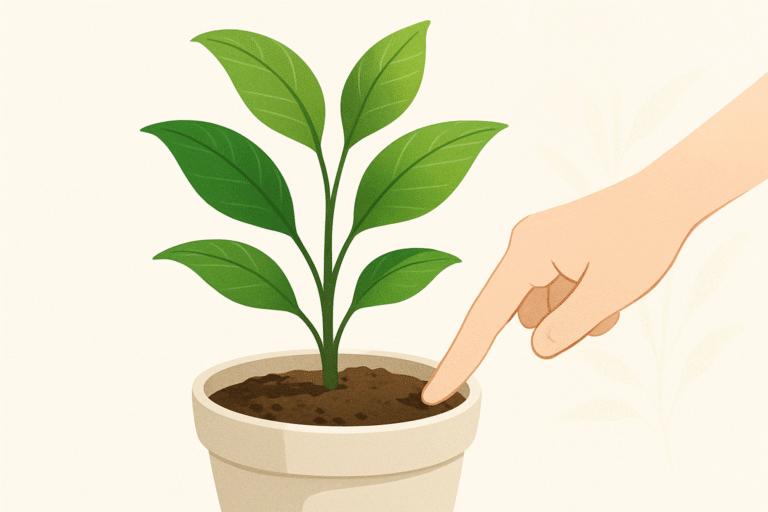
The solution is disarmingly simple and profoundly effective. It’s the finger test.
Before you even think about picking up your watering can, insert your index finger into the plant’s soil, up to about the first knuckle. What do you feel? Is the soil cool and damp, clinging to your skin? Then put the watering can down. The plant is fine. Walk away. Is the soil dry, dusty, and pulling away from the sides of the pot? Then, and only then, is it time to water.
This one simple act changed everything for me. It forced me to stop imposing my schedule on the plant and start responding to what the plant was telling me. It’s the difference between shouting instructions and having a conversation.
Choosing Your Tools and Why It Matters
I used to just use a drinking glass to water my plants. It seemed efficient. But I was often just splashing water onto the leaves and the top millimeter of soil, while the roots below remained bone dry. Or I’d misjudge and flood the whole thing, creating a swampy mess.
Investing in a watering can with a long, narrow spout felt like a ridiculously professional step at first, but it made a huge difference. That narrow spout gives you control. It allows you to direct the water exactly where it needs to go: onto the soil, around the base of the plant. This ensures the water gets down to the root system, where it’s actually absorbed. It prevents wasteful and potentially harmful splashing on leaves, which can lead to fungal issues for some plants. It’s a small change, but it turns a clumsy chore into a precise, nurturing act.
A Guide to Feeding Your Leafy Friends
Decoding Plant Food for a Happy Home
Once I got watering down, I thought I was set. But then my plants, while alive, looked a bit… sad. Their growth was slow, the leaves a little pale. They were surviving, but not thriving. They were hungry.
Plant food, or fertilizer, feels intimidating. The packages are covered in numbers and chemical names. But the basics are quite straightforward. Think of it as tailoring a diet. For most of my leafy, non-flowering plants—the monsteras, the pothos, the ZZ plants—the goal is lush, green foliage. The nutrient that promotes this is nitrogen. So, I look for a fertilizer that is high in nitrogen. It’s that simple.
For plants that I want to encourage to bloom, like an orchid or an African violet, the nutritional needs shift. They require more potassium, often represented by the letter ‘K’ (or K2O) on the label. This nutrient helps the plant with the energy-intensive process of producing flowers. It is also worth noting that some plants are picky eaters. Cacti, succulents, and orchids have very specific needs, and buying a specialized feed designed for them is the easiest way to give them exactly what they crave. Don’t try to give a cactus the same meal as a fern.
Timing is Everything When It comes to Fertilizer
Giving a plant food at the wrong time is like serving a massive feast to someone who is sound asleep. It’s useless at best and harmful at worst. Plants have a natural cycle of active growth and dormancy. For most houseplants, the growth period is in the spring and summer when the days are longer and warmer. This is when you’ll see new leaves unfurling and new stems stretching out. This is the time to feed them.
During the fall and winter, most plants enter a dormant or semi-dormant state. Their growth slows down dramatically as they conserve energy. Fertilizing during this period can burn their roots, as they aren’t actively using the nutrients. I generally feed my plants every few weeks during the growing season and stop completely around October, resuming again in March or April. For those who want a lower-maintenance approach, slow-release fertilizers that you mix into the soil can be a great option, providing a steady, gentle supply of nutrients over several months.
Finding the Perfect Spot of Sun or Shade
Learning to Read the Light in Your Home
I used to think a window was a window. If a plant needed light, I put it on a windowsill. If it needed shade, I put it in a dark corner. This oversimplification led to more than a few casualties, from sunburned leaves to leggy, stretched-out stems reaching desperately for a stray sunbeam.
The real skill is learning to read the light in your own space. Spend a day just noticing it. Where do the direct, intense beams of sun fall in the morning? Where does that light land in the afternoon? Which rooms are filled with a gentle, ambient glow all day? Which corners never see a direct ray of sun but are still bright enough to read a book in? Every home has a unique light profile, determined by the direction its windows face, the time of year, and even obstructions like trees or buildings outside. Becoming an observer of this daily light show is the first step to putting your plants in a place where they will be happy.
What Semi-Shade and Bright Indirect Light Really Mean
Plant tags are full of jargon, and “bright, indirect light” is probably the most common and most confusing phrase of all. Here’s my personal translation: It means a spot where the plant can see a wide view of the sky, but the sun’s rays aren’t hitting it directly. Think of a spot a few feet back from an east-facing window, or a place in a bright room that is shielded from the direct southern or western sun. My cheeseplant (Monstera deliciosa) loves this kind of spot.
Then you have the low-light champions. Plants like the Sansevieria (snake plant) and Aspidistra (cast iron plant) are famous for their tolerance of shadier conditions. They can be placed much farther from a window, making them perfect for brightening up less-lit areas of a room.
“Semi-shade” is that happy medium. A spider plant, for example, thrives here. It could be near a window that doesn’t get much direct sun, or in a spot that gets maybe an hour of gentle morning sun. The key is understanding these are not absolute rules but descriptions of a preferred environment.
Creating a Cozy Environment for Your Plants
The Quest for a Stable Temperature
Plants are more sensitive to their surroundings than we often realize. While most common houseplants are quite comfortable in the same temperature range we are—somewhere between 15 and 25 degrees Celsius (55-75 F)—what they truly dislike are sudden, dramatic shifts.
A plant placed right next to a heating vent will get blasted with hot, dry air all winter. One on a windowsill might be fine during the day but get hit with a cold draft from the glass all night. These fluctuations are stressful. The plant has to constantly adjust, which consumes energy that could be used for growth. The solution is simple situational awareness. I keep my plants away from radiators, air conditioning units, and drafty doorways. Providing a stable temperature is one of the easiest, most passive ways to keep them content.
Simple Tricks to Boost Humidity
Many of the most popular houseplants, like ferns, calatheas, and marantas, originate from tropical rainforest floors. They are built for a humid environment. Our centrally heated homes are often the exact opposite of that; they are deserts. A lack of humidity is why you might see crispy brown edges on your fern’s fronds, even if you are watering it correctly.
I have found a couple of simple methods to create little pockets of humidity. One effective trick is to place a plant’s pot inside a slightly larger, decorative pot with no drainage holes. I then fill the gap between the two pots with small stones or even leftover compost. When I water the plant, any excess water collects in the outer pot and among the stones, slowly evaporating and raising the ambient humidity right around the plant.
Another fantastic method is simply to group your plants. Plants naturally release moisture through their leaves in a process called transpiration. When you cluster several plants together, they create their own tiny, humid microclimate. They help each other out. For a quick, temporary boost, especially on a hot day, a light misting with a spray bottle can provide immediate relief.
The Art of Knowing When to Repot
There comes a time in most plants’ lives when their home just gets too small. Repotting sounds like a major, messy operation, and for a long time, I avoided it. I was afraid I would damage the roots and kill the plant. But an pot-bound plant will eventually stop growing, as its roots run out of room to expand and exhaust the nutrients in the soil.
Learning when to repot is another act of observation. The most definitive check is to gently remove the plant from its pot. I turn the pot on its side, tap it firmly all around to loosen the soil, and then carefully slide the entire plant out. If what I see is a dense, tangled mass of roots with very little visible soil, it’s time for a new home. The plant is literally all root and has nowhere left to go.
When I do repot, I only go up one pot size—about an inch or two wider in diameter. Moving a plant into a pot that is too large can lead to the soil staying wet for too long, causing root rot. It’s also important to know that some plants, like the ZZ plant or certain orchids, almost prefer to be a little snug in their pots and don’t appreciate having their roots disturbed often. So, as with everything, it pays to know your specific plant’s preferences.
The Joy of Watching Them Thrive
My home is no longer a plant graveyard. It is a living, breathing space that I share with dozens of green companions. The greatest reward of this journey was not just acquiring a beautiful, green interior. It was the shift in my own perspective.
There is a quiet, profound satisfaction that comes from watching a new leaf unfurl. There is a simple happiness in seeing a plant that was once struggling put out healthy, vibrant growth. It taught me patience. It taught me to pay attention to the small, subtle signals of the living world around me. It is a connection, a small daily practice of nurturing something outside of myself. And it’s a joy that I now know is not reserved for a select few with a “green thumb,” but is available to anyone willing to stop, look, and listen.