
Introduction: Why I Believe Vitamin C Is Our Body’s Unsung Hero
In the vast world of nutrition, certain vitamins get all the attention. Vitamin D is the sunshine vitamin, B vitamins are the energy boosters. And then there is Vitamin C. Most people associate it with a glass of orange juice when they feel a sniffle coming on. To me, that’s like saying a master architect is just a person who is good with bricks. It completely misses the point.
I believe Vitamin C is one of the most profoundly important, yet consistently underestimated, nutrients for human health. It doesn’t just help with colds; it is a fundamental operator in the complex machinery of our bodies, a silent guardian working at the cellular level every single moment of our lives. Its story is not one of a single function, but of a versatile and indispensable partnership with our biology. It’s a story I feel is worth telling with the conviction it deserves.
This is why I see it as our body’s true champion.
The Everyday Miracle of Oxidation
Have you ever watched an apple slice turn brown after being left on the counter? Or seen an old iron gate surrender to a coat of rust? This is a process I find fascinating, a visible, slow-motion display of decay called oxidation. It happens all around us. It is a fundamental chemical reaction, a part of the natural order of things.
That same process, that same slow decay, is happening inside our bodies.
But there’s a simple kitchen trick that demonstrates a profound biological truth. If you dip that apple slice in lemon juice, the browning slows to a crawl. The secret ingredient fighting back against the decay is Vitamin C. The ascorbic acid in the lemon juice acts as a shield, slowing the rate of oxidative damage. This simple act is a perfect metaphor for the constant, invisible battle Vitamin C wages on our behalf, protecting our very cells from a similar fate.
More Than Just a Vitamin
When it was first identified about a century ago, Vitamin C quickly earned a reputation as a kind of “wonder worker.” This was not hyperbole. Scientists were beginning to understand its foundational role in building and maintaining the body. Its scientific name, ascorbic acid, literally means “without scurvy,” pointing to its historic power to prevent that devastating disease of collagen breakdown.
This is where we move beyond the simple idea of a vitamin. Vitamin C is a key player in collagen formation, the protein that literally holds us together. It is the scaffolding for our skin, bones, and connective tissues. It is also a potent agent for our immune system and a tireless fighter against cellular damage. It has been shown to help our bodies fend off everything from minor daily afflictions to supporting the system against much more serious conditions. It’s a nutrient that performs double duty, building us up while simultaneously protecting us from breaking down.
The Body’s Essential Partnership with Vitamin C
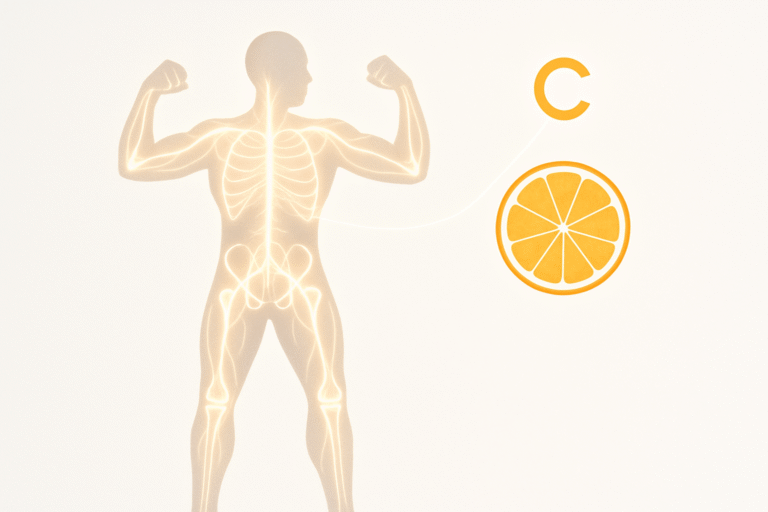
Our relationship with Vitamin C is, in my opinion, one of the most compelling stories of co-dependence in human biology. It is a partnership, but a one-sided one. We are entirely reliant on it, and our bodies are in a constant state of demand.
We Can’t Make It, So We Must Take It
Here is a peculiar fact of our biology: humans cannot produce their own Vitamin C. We simply lack the necessary genetic machinery. We share this strange inability with a small club of other animals, including our primate cousins and guinea pigs. For us, there is no internal factory churning out ascorbic acid when supplies run low.
Our survival depends on getting it from external sources.
This reality places an enormous responsibility on our daily choices. We have no alternative but to obtain this life-sustaining nutrient through the foods we eat or the supplements we take. It’s not a recommendation; it is a biological imperative. This absolute dependency underscores its importance in a way few other nutrients can claim. We must consciously and consistently provide our bodies with what they cannot provide for themselves.
The Foundation of a Strong Body
As I mentioned, Vitamin C’s role in collagen synthesis is one of its most critical, yet least celebrated, functions. Collagen is the most abundant protein in our bodies. Think of it as the biological glue and framework for your entire physical form. It gives structure to your skin, strength to your bones, flexibility to your joints, and integrity to your blood vessels.
Without an adequate supply of Vitamin C, this entire production line grinds to a halt. The body simply cannot create strong, stable collagen. The consequences are systemic, affecting everything from skin elasticity to wound healing and joint health. When I consider this, I don’t see Vitamin C as just another supplement in a bottle. I see it as the master mason, laying the very foundation of a strong and resilient body.
A Powerful Ally for Your Immune System
The most common reason people reach for Vitamin C is for immune support, and for good reason. My view, however, is that its role here is far more sophisticated than simply fighting off a cold. It is a commander, an equipper, and a motivator for our body’s internal defense forces.
Arming Our Cellular Soldiers Against Infection
I like to think of our immune system as a standing army, with different types of cells acting as specialized soldiers. Among the most important are phagocytes and neutrophils, cells that hunt down and destroy invading pathogens like bacteria and viruses.
Vitamin C is the quartermaster for this army. It stimulates the activity of these cellular soldiers, making them more aggressive, more mobile, and more effective at their job. It strengthens and protects the entire immune system, ensuring our defenses are not just present, but are armed, active, and ready to respond to threats. It fortifies our internal garrison against a constant barrage of potential invaders.
Moving Beyond the Common Cold
The association with the common cold is so strong that it almost does a disservice to Vitamin C’s true power. Yes, a good supply can help support the body when you are sick. But its benefits extend far beyond that. By bolstering our primary lines of defense, it can enhance our resistance to a wide spectrum of diseases.
Its ability to protect the immune system is a core part of its preventive capacity. There is even a body of research exploring its use in very high, intravenously-administered doses as a supportive therapy in some cancer treatments. This illustrates a potential that goes well past the sniffles. It’s about building a fundamentally stronger and more responsive immune system for the long haul.
The Ultimate Cellular Protector: An Antioxidant Powerhouse
For me, the most compelling aspect of Vitamin C is its role as an antioxidant. This is where it performs its most elegant and vital work, fighting an invisible war that determines our long-term health and the very pace at which we age.
Understanding the Invisible War on Our Cells
Every day, our bodies’ normal metabolic processes—the very acts of turning food into energy and sustaining life—create unstable by-products. These are called free radicals. I think of them as tiny, chaotic sparks flying off a grinding wheel. They are molecules missing an electron, which makes them highly reactive and destructive. In their quest to become stable, they steal electrons from healthy cells, causing a chain reaction of damage known as oxidative stress.
This cellular damage is not a minor issue. It is a primary driver of aging and a contributing factor in many chronic and degenerative diseases. This is the internal, silent version of the apple turning brown. It is a constant, low-grade assault on our very essence.
How Vitamin C Fights and Wins Against Free Radicals
This is where our hero steps in. Vitamin C is a supreme antioxidant because it is an incredibly generous source of electrons. It willingly donates its own electrons to these rampaging free radicals, effectively neutralizing them. It quenches their reactivity and stops the chain of damage before it can spiral out of control. It is the ultimate peacemaker at the molecular level.
Because ascorbic acid is water-soluble, it can perform this protective function both inside and outside our cells, patrolling the fluid-filled environments of our bodies where so much of this oxidative damage occurs. It gets to the free radicals and disarms them before they can inflict too much harm. It’s a simple, elegant, and profoundly effective defense mechanism.
A Team Player: Revitalizing Other Antioxidants
What truly elevates Vitamin C, in my mind, is that it is not a lone wolf. It works in concert with other antioxidants in the body, making the entire system more robust. One of its most impressive feats is its ability to regenerate Vitamin E.
Vitamin E is a fat-soluble antioxidant, meaning it protects the fatty parts of our bodies, like cell membranes. After Vitamin E neutralizes a free radical, it becomes depleted. Vitamin C can step in and donate an electron back to the spent Vitamin E, essentially recharging it and putting it back into the fight. So, not only does Vitamin C directly scavenge free radicals, it also helps recycle other key protectors. It’s a true team player, enhancing the body’s entire antioxidant network.
The Other Side of the Story: My Final Take
No discussion is complete without looking at all sides of an issue. There has been some scientific conversation about Vitamin C that I believe is important to address, as it directly impacts how we perceive its role as a protector.
Acknowledging the Pro-Oxidant Debate
Some research has suggested that under very specific conditions, particularly in the presence of certain metal ions, Vitamin C can act as a “pro-oxidant.” This means it could potentially contribute to oxidative stress instead of preventing it. This idea has understandably caused concern for people who regularly take it to protect their health.
It’s a valid scientific inquiry. The body’s chemistry is incredibly complex, and context matters. However, I feel it is vital to understand that these pro-oxidant effects are typically observed in laboratory settings under conditions that do not necessarily reflect the intricate, balanced environment of the human body.
Why I Still Champion This Essential Nutrient
After considering the evidence, my conviction remains unshaken. I firmly believe that for the overwhelming majority of people, living their daily lives, the net effect of Vitamin C is powerfully and consistently antioxidative. The balance required for optimal health—a balance between the generation of free radicals and the protection against them—is heavily tilted in our favor by maintaining a sufficient supply of ascorbic acid.
The potential for a pro-oxidant effect under niche, isolated conditions does not, in my opinion, negate its immense and proven benefits as a foundational nutrient, an immune system ally, and a primary cellular protector. Its role is too fundamental, its partnership with our biology too essential. It remains, in my view, one of the most reliable, effective, and important molecules for maintaining human health. It’s a wonder worker that asks for very little but gives an extraordinary amount in return.