

Coffee Recalls 2026: What You Need to Know About Recalled Coffee Brands, Health Risks, and What to Do Next
Last updated: September 6, 2026
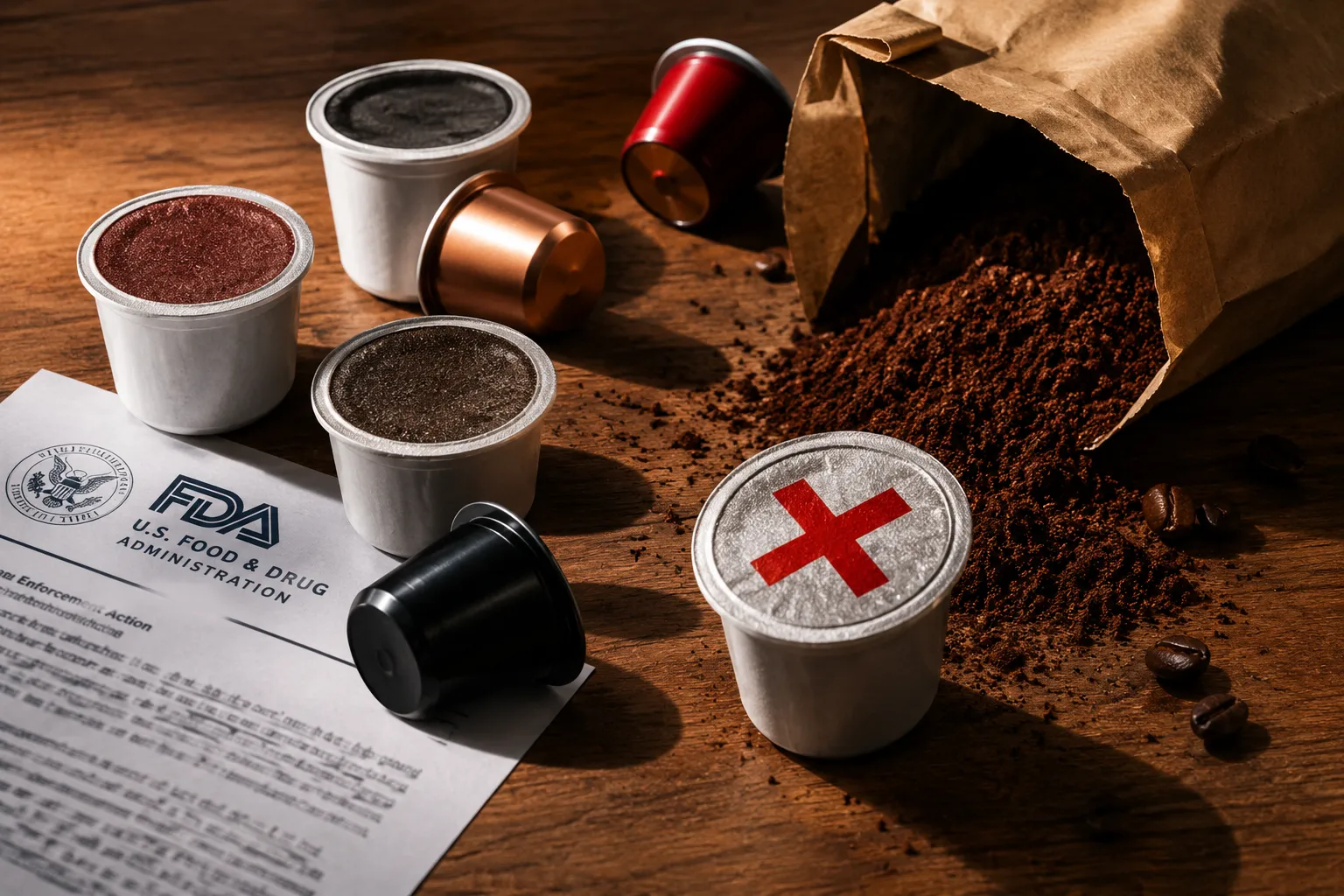
Quick Answer: Coffee recalls in 2026 have involved mislabeled decaf pods, botulism risk in cold brew, glass fragments in instant coffee, and Salmonella-contaminated ground coffee. If you have a recalled product, stop using it immediately, check the FDA's recall database, and contact the retailer for a refund.
Key Takeaways
- In January 2026, Keurig Dr Pepper recalled over 80,000 McCafe Premium Roast Decaf K-Cup pods after discovering some pods labeled decaf may actually contain caffeinated coffee, posing risks to people with heart conditions or pregnancy-related caffeine restrictions. [5]
- Brooklyn Roasting Company recalled 1,219 units of cold brew concentrate in July 2026 due to potential botulism risk from improper ambient storage. [2]
- Dollar General recalled Clover Valley Instant Coffee across 48 states in August 2025 after a customer reported possible glass fragments. [3]
- More than 600 bags of Royal coffee powder were recalled in June 2026 for potential Salmonella contamination. [14 – see note below]
- The FDA classifies coffee recalls as Class II (moderate risk) or Class III (low risk) depending on the severity of the hazard. [7]
- Consumers can check the FDA's official recall database at fda.gov to verify whether their specific coffee product is affected.
- Decaf coffee labeling errors are a growing concern, with multiple coffee recalls in 2025 and 2026 involving caffeinated coffee mislabeled as decaf.
Why Coffee Recalls Happen: The Main Causes
Coffee recalls occur when a product poses a risk to public health or violates food safety regulations. The Food and Drug Administration (FDA) and other food safety authorities issue recalls when contamination, mislabeling, or packaging defects are discovered, either through company testing, consumer complaints, or regulatory inspections.
The three most common causes behind recent coffee recalls are:
- Contamination: Biological hazards such as Salmonella, botulism-causing bacteria (Clostridium botulinum), or physical contaminants like glass fragments.
- Caffeine labeling errors: Decaf coffee pods or ground coffee recalled because they actually contain caffeinated coffee, which can cause adverse health consequences for people who must avoid caffeine.
- Packaging defects: Issues such as label ink that smudges at high temperatures, which may not present a direct food safety hazard but still require corrective action under FDA rules.
According to the FDA, the drug administration classifies recalls by risk level. A Class II recall means the product may cause temporary, medically reversible adverse health effects. A Class III recall means the product is unlikely to cause any adverse health consequences but still violates regulations. [7]
Recent Coffee Recalls 2025 and 2026: A Full Rundown
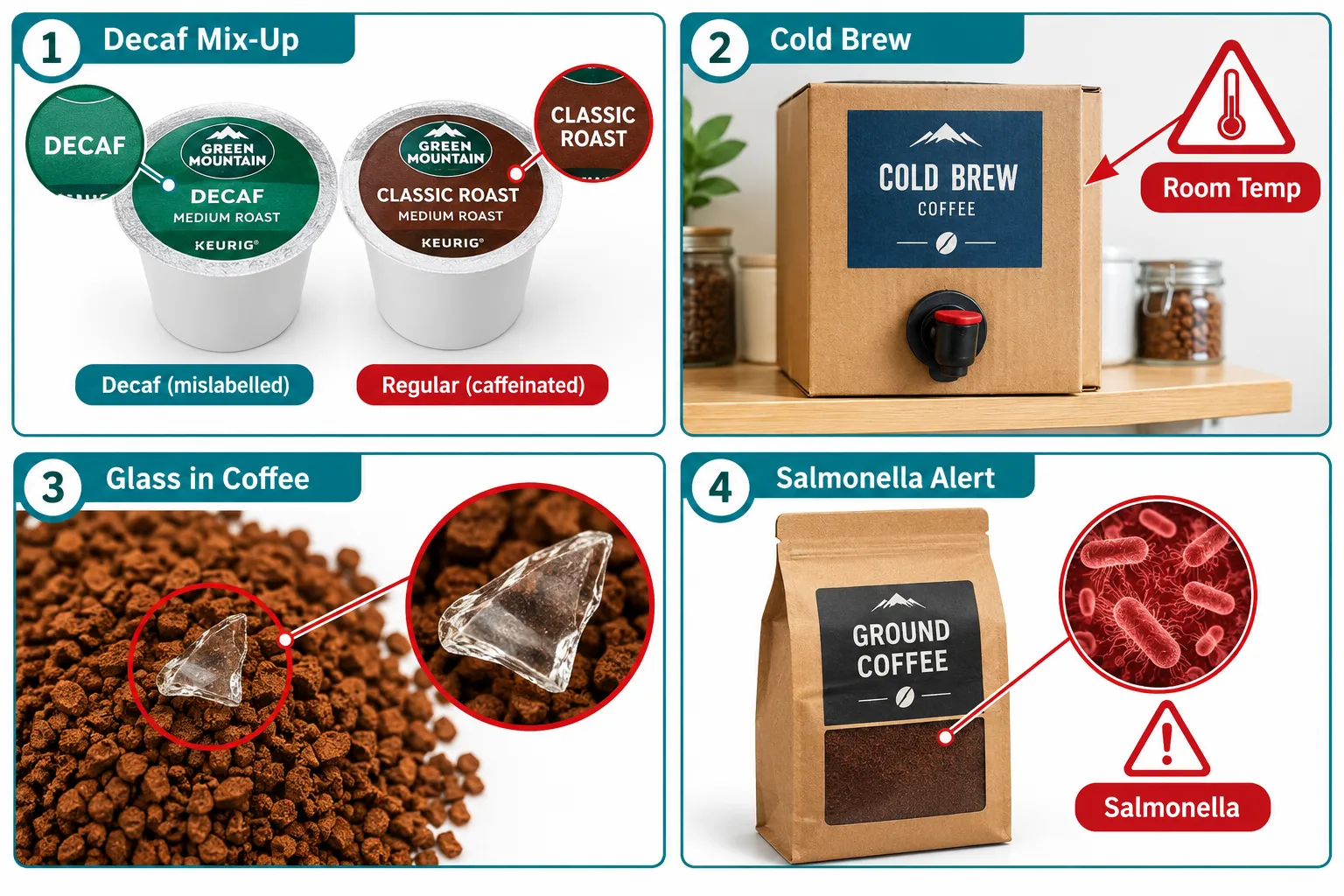
Several significant coffee recalls have occurred across 2025 and 2026, affecting pods, ground coffee, cold brew, and instant coffee products sold across the United States and internationally.
McCafe Decaf K-Cup Pods Recall (January 2026)
In January 2026, Keurig Dr Pepper initiated a recall of about 80,600 McCafe Premium Roast Decaf K-Cup coffee pods after a caffeine labeling error was discovered. [5] Some pods labeled as decaf coffee may have actually contained regular caffeinated coffee. The FDA and the drug administration treated this as a formulation and labeling error rather than contamination. Although no injuries were reported, the recall was justified because unintended caffeine consumption poses real risks for people with hypertension, cardiac arrhythmias, or those who are pregnant. [8][9]
- Affected states included Indiana and others across the U.S.
- Customers were advised to stop using the pods and contact Keurig for a refund.
- This coffee recall was classified as Class II by the FDA, indicating a moderate health risk.
Brooklyn Roasting Company Cold Brew Recall (July 2026)
Brooklyn Roasting Company recalled 1,219 units of its Pasteurized Cold Brew Concentrate in July 2026, affecting wholesale customers in New York and New Jersey. [2][4] The product, a 2.5-gallon bag-in-box, was distributed between April 1 and June 20, 2026, with best-by date codes ranging from 063026 through 093026. The problem: this low-acid cold brew coffee was stored at ambient (room) temperature instead of being refrigerated, which can allow Clostridium botulinum toxin to form in improperly processed beverages. The FDA elevated this to a Class II recall. [4]
Which cold brew is being recalled? The Brooklyn Roasting Company Pasteurized Cold Brew Concentrate, distributed wholesale in New York and New Jersey, is the cold brew product subject to this 2026 recall. Check the best-by date on your product against the codes 063026 through 093026 to determine if your unit is affected. [2]
Why was the cold brew recalled? The cold brew was recalled because ambient storage of this low-acid product can allow Clostridium botulinum bacteria to produce toxin. Botulism is a serious illness caused by a nerve toxin; even small amounts can cause muscle paralysis, breathing difficulty, and in severe cases, death. The FDA's Class II classification indicates a moderate rather than immediate high risk, but the agency and the company still urged affected customers to stop use immediately. [4]
What is botulism, and how can it be dangerous? Botulism is a rare but potentially life-threatening illness caused by toxins produced by Clostridium botulinum bacteria. It can cause symptoms including double vision, drooping eyelids, slurred speech, difficulty swallowing, and progressive muscle weakness. Improperly stored low-acid beverages like cold brew coffee are a known risk environment for this bacteria. Anyone who has consumed the recalled cold brew and experiences these symptoms should seek medical care immediately. [2][4]
Dollar General Clover Valley Instant Coffee Recall (August 2025)
Dollar General announced a voluntary recall of three lots of its 8-ounce Clover Valley Instant Coffee on August 11, 2025, after a customer reported possible glass fragments. [3][6] The recall affected stores across 48 U.S. states (all except Alaska and Hawaii) where the product was sold between July 9 and July 21, 2025. The UPC was 876941004069, with lots L-5163, L-5164, and L-5165, and best-by dates of December 13-14, 2026. Ingesting glass can cause lacerations in the mouth and throat or perforation of the intestine. Customers were instructed to discard the coffee and contact Dollar General for a full refund. [1][3]
Royal Coffee Powder Recall (June 2026)
In June 2026, more than 600 bags of Royal coffee powder sold in New York and New Jersey were recalled following FDA notification of potential Salmonella contamination. Officials warned the product could cause gastrointestinal illness and pose particular risk for children, older adults, and people with weakened immune systems.
Our Traverse City Decaf Ground Coffee Recall (March 2025)
The FDA announced a recall of thousands of pounds of Our Traverse City Decaf Light Roast ground coffee in 12-ounce bags in March 2025. The product had been distributed across 15 U.S. states and was mistakenly labeled as decaffeinated despite containing regular caffeinated coffee. The FDA categorized this as a Class II recall due to the possibility of temporary, medically reversible adverse health effects from unintended caffeine consumption. This is a clear example of a coffee recall driven purely by a caffeine labeling error rather than contamination.
Gimme Coffee and Gimme Decaf Agua Coffee Pods
Among the products that have drawn consumer news attention, Gimme Coffee products, including Gimme Decaf and Gimme Decaf Agua coffee pods, have been discussed in connection with the broader category of decaf pods to use as safe alternatives when other products are recalled. Agua coffee pods and Gimme Decaf Agua coffee remain popular choices for consumers seeking certified decaf coffee options. Always verify the best-by date and lot information on any decaf pods you purchase.
Saudi Arabia Coffee Warning (August 2026)
On August 6, 2026, Saudi Arabia's Food and Drug Authority warned consumers to stop using three coffee and chocolate products containing ginseng after lab testing detected Nortadalafil, a prohibited pharmacologically active substance. The affected products included Parsa Coffee (Coffee with Ginseng) and Bintan SKY (Coffee with Ginseng). [10] This international news underscores that coffee product safety is a global concern, not limited to the U.S. FDA.
Which Coffee Brands Have Been Recalled: A Quick Reference
The following brands and products have been involved in notable coffee recalls in 2025 and 2026:
| Brand / Product | Recall Reason | Year | Risk Class |
|---|---|---|---|
| McCafe Premium Roast Decaf K-Cup pods | Caffeine labeling error (decaf mislabeled) | 2026 | Class II |
| Brooklyn Roasting Co. Cold Brew | Botulism risk (improper storage) | 2026 | Class II |
| Royal Coffee Powder | Salmonella contamination | 2026 | Class II |
| Clover Valley Instant Coffee | Glass fragments | 2025 | Class II |
| Our Traverse City Decaf Ground Coffee | Caffeine labeling error | 2025 | Class II |
| Dark Pinon Single-Serve Coffee Pods | Label ink smudging defect | 2025 | Class III |
| Multiple canned coffee/tea products (549,146 cans) | Processing/packaging failures | 2024 | Class II |
Coffee Recall Health Risks: What to Watch For
The health risks from recalled coffee depend on the specific hazard involved. Mislabeled decaf coffee can trigger rapid heartbeat, elevated blood pressure, anxiety, or insomnia in people sensitive to caffeine. Contaminated cold brew or ground coffee can cause botulism symptoms (muscle weakness, vision problems, difficulty breathing) or Salmonella symptoms (diarrhea, fever, stomach cramps). Physical contaminants like glass can cause cuts or internal injury.
Symptoms to watch for after consuming recalled coffee:
- Gastrointestinal distress: nausea, vomiting, diarrhea, stomach cramps (Salmonella or botulism)
- Neurological symptoms: drooping eyelids, blurred vision, difficulty swallowing (botulism)
- Cardiovascular symptoms: rapid heartbeat, elevated blood pressure (unintended caffeine)
- Mouth or throat pain, difficulty swallowing (glass fragments)
If you experience any of these symptoms after consuming a recalled coffee product, seek medical care promptly. Report adverse health consequences to the FDA's MedWatch program at fda.gov.
How to Check If Your Coffee Is Recalled
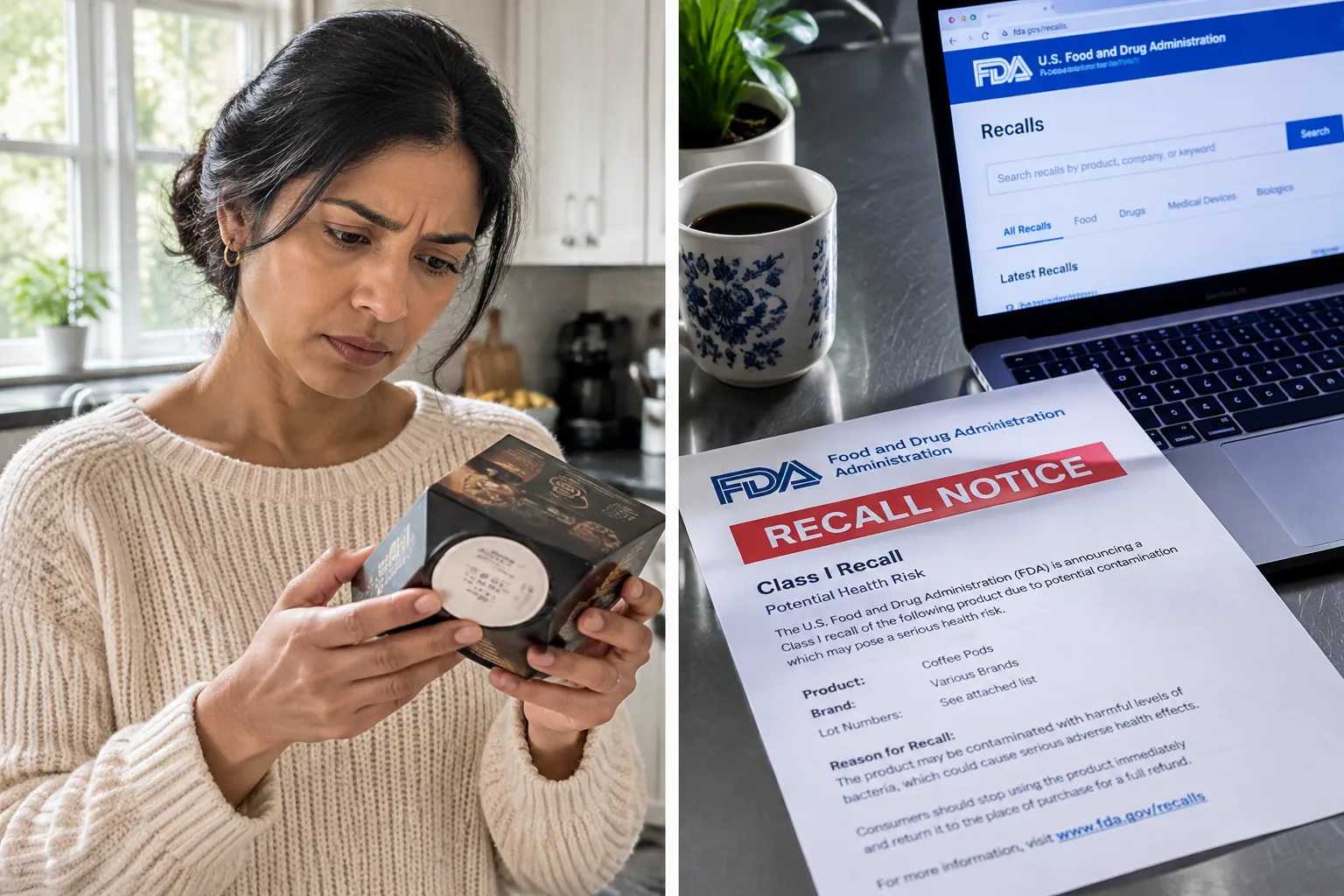
The fastest way to check whether your coffee product is recalled is to visit the FDA's official recall database at fda.gov/safety/recalls-market-withdrawals-safety-alerts. You can search by brand name, product type, or date range.
Step-by-step process:
- Locate the UPC code, lot number, and best-by date on your coffee packaging.
- Visit fda.gov and search the recalls database for your brand or product name.
- Compare your lot number and best-by date against the specific codes listed in the recall notice.
- If your product matches, stop using it immediately.
- Contact the retailer or manufacturer for a refund or replacement.
For coffee pods, check the bottom or side of the pod packaging for the best-by date and lot code. For ground coffee recalled products, the lot number is typically printed on the bottom of the bag. The FDA also issues news releases and posts recall alerts on its social media channels, including Twitter, so following the FDA account is a practical way to stay informed about new coffee recalls.
How to Get a Refund for Recalled Coffee
Customers with recalled coffee products are generally entitled to a full refund. The standard FDA process for recalls involving physical contaminants or food safety hazards requires companies to offer remedies to affected customers.
- For Keurig/McCafe pods: Contact Keurig Dr Pepper customer care directly. The company set up a dedicated process for the decaf pods recall. [5][9]
- For Clover Valley Instant Coffee: Contact Dollar General customer care with your purchase information. The company instructed customers to discard the product and request a full refund. [1][3]
- For cold brew products: Contact the distributor or retailer where the product was purchased.
- For other recalled coffee brands: Check the specific recall notice on fda.gov for the company's contact information and refund instructions.
Keep your receipt or proof of purchase if possible, but many companies will process refunds based on a photo of the product or packaging alone.
Coffee Recall vs. Expiration Date: What Is the Difference?
A recall is not the same as an expiration or best-by date. A best-by date indicates when a manufacturer expects peak quality, not necessarily safety. A recall is an action taken because a product poses a specific, identified health or safety risk, regardless of the best-by date. In some cases, such as the Brooklyn Roasting cold brew recall, the best-by date codes are used to identify which specific units are affected, but the recall itself is driven by a safety hazard, not by the product being old or stale. [2][4]
If your coffee is past its best-by date but has not been recalled, it may taste stale but is generally not a health risk. If your coffee is within its best-by date but has been recalled, stop using it immediately.
Is Instant Coffee Safer Than Ground Coffee During Recalls?
Instant coffee is not inherently safer than ground coffee from a recall standpoint. Both product types have been subject to significant recalls in recent years. The Clover Valley Instant Coffee recall involved glass fragments, while ground coffee recalled products have included caffeine labeling errors and Salmonella contamination. The risk depends entirely on the specific hazard, not the coffee format. Cold brew coffee, coffee pods, and canned ready-to-drink coffee have each had their own recall events.
The best approach is to check the FDA recall database for any coffee product you use regularly, regardless of format.
Decaf Coffee Pods to Use Instead of Recalled Products
If your decaf coffee pods have been recalled, several well-regarded alternatives are widely available. When selecting decaf pods, look for products that clearly state the decaffeination method (Swiss Water Process or CO2 method are considered the cleanest) and that carry third-party certifications.
- Victor Allen's Coffee Decaf Coffee Variety Pack offers a range of decaf flavors in pod format and is widely available through major retailers and online deals.
- Amazon Brand Happy Belly Decaf Light Roast Coffee Pods are a budget-friendly option with consistent labeling and quality control.
- San Francisco Bay Compostable Coffee Pods Organic Rainforest Blend offers a decaf option with compostable pods and organic certification, appealing to health- and environment-conscious consumers.
- Gimme Decaf and Gimme Decaf Agua coffee pods are popular among consumers seeking organic decaf options with transparent sourcing.
Always verify the best-by date on any new pods you purchase, and check that the product has not appeared on the FDA's coffee recall list before use.
What to Do If You Have Recalled Coffee or Have Already Consumed It
Stop using the product immediately and do not serve it to others. Seal it in a bag and store it separately to avoid confusion. Check the specific recall notice for disposal instructions, as some recalls require the product to be returned rather than discarded.
If you have already consumed the recalled coffee:
- Monitor yourself for any symptoms related to the specific hazard (caffeine effects, gastrointestinal illness, or signs of botulism).
- Contact your healthcare provider if you experience any adverse health effects.
- Report the issue to the FDA's MedWatch program.
- Contact the company or retailer for a refund, even if you have already consumed part of the product.
What should you do if you have the recalled cold brew, or you have consumed it? Discard the Brooklyn Roasting Company cold brew immediately if the best-by date code falls between 063026 and 093026. If you have consumed it and experience symptoms such as double vision, drooping eyelids, or difficulty swallowing, seek emergency medical care at once, as these may indicate botulism. Contact your healthcare provider even if symptoms seem mild. [2][4]
Why You Should Clean Your Coffee Maker Regularly
Recalled coffee products are not the only coffee-related health concern at home. Coffee makers that are not cleaned regularly can harbor mold, bacteria, and mineral buildup that affect both the taste and safety of your brew coffee. Health experts recommend cleaning your coffee maker at least once a month. For pod-based machines, descale every one to three months depending on water hardness. Wipe down the drip tray and pod holder after each use. A clean machine also helps you detect any unusual odors or residues that might indicate a product issue, including contamination from a recalled coffee product.
Stay Informed: How to Track Coffee Recalls in 2026
Staying current on coffee recalls in 2026 is straightforward with the right sources. The FDA posts all active recalls at fda.gov, and you can sign up for email alerts filtered by product category. NBC news outlets, including NBC Chicago, have covered major recalls such as the Keurig decaf pods recall in detail. [9] Health-focused publications like Health.com and Good Housekeeping also publish timely recall news for consumers. [4][8]
For deals and sales on replacement products after a recall, major retailers often run promotions on alternative coffee brands. Check the home page of your preferred retailer for deals and amp up your savings while restocking safely.
The FDA's drug administration enforcement reports are published weekly and include all new Class II and Class III recalls, making them a reliable resource for anyone tracking the FDA recall list for coffee products including Green Mountain coffee recall updates, Keurig recall lists, and other brand-specific actions.
FAQ: People Also Ask About Coffee Recalls
What blood pressure pills are being recalled?
Several blood pressure medications have been subject to recalls in recent years due to contamination with nitrosamine impurities, including losartan, valsartan, and irbesartan. For the most current and specific information about blood pressure pill recalls, check the FDA's official recall database at fda.gov, where all active drug recalls are listed by product name, lot number, and reason for recall. Always consult your healthcare provider before stopping any prescribed medication.
Is Starbucks coffee being recalled?
As of September 2026, there is no active FDA recall specifically targeting Starbucks-branded coffee products sold in retail stores. Starbucks has not appeared on the FDA's current coffee recall list. However, consumers should always verify by checking fda.gov directly, as recall status can change. Past recalls in the broader coffee category have not involved Starbucks retail coffee products, though individual store equipment and procedures are subject to separate health department oversight.
Is there a recall on Keurig coffee?
Yes, in January 2026, Keurig Dr Pepper recalled approximately 80,600 McCafe Premium Roast Decaf K-Cup pods due to a caffeine labeling error, meaning some pods labeled as decaf coffee may have actually contained caffeinated coffee. [5][9] This recall affected multiple U.S. states. There is no separate recall of Keurig coffee makers themselves as of September 2026, though consumers can check the Consumer Product Safety Commission (CPSC) database for any appliance-related Keurig recall information.
Why is Coke being recalled?
Coca-Cola product recalls are separate from coffee recalls and are typically issued for reasons such as undeclared allergens, foreign material contamination, or packaging defects. As of September 2026, no major nationwide Coke recall is active in the United States. For the most accurate and current information about any Coke or beverage recall, check the FDA's recall database at fda.gov or the official Coca-Cola consumer care page. Recall status changes frequently, so always verify directly with the FDA.
Conclusion: Actionable Next Steps for Coffee Consumers
Coffee recalls are more common than most consumers realize, and the risks range from minor labeling issues to genuine food safety hazards. Here is what to do right now:
- Check your coffee products today. Look up the brand, lot number, and best-by date on the FDA recall database at fda.gov.
- Sign up for FDA recall alerts filtered to food and beverage products so you receive news about new coffee recalls automatically.
- If you have a recalled product, stop using it immediately and follow the company's refund instructions.
- Seek medical care if you experience any symptoms after consuming a recalled coffee product, especially if botulism or Salmonella contamination is involved.
- Clean your coffee maker monthly to reduce secondary risks from mold or bacteria buildup.
- Choose replacement decaf coffee pods carefully, verifying that the product is not on any active recall list before purchase.
Staying informed is the most effective way to protect your health and the health of your household from risks associated with recalled coffee products in 2026 and beyond.
References
[1] Coffee Sold In 48 States Is Recalled For Potential Glass Fragments – https://people.com/coffee-sold-in-48-states-is-recalled-for-potential-glass-fragments-11790115 [2] Cold Brew Coffee Recall Brooklyn Roasting Company July 2026 – https://www.thehealthy.com/news/cold-brew-coffee-recall-brooklyn-roasting-company-july-2026/ [3] Dollar General Announces Voluntary Recall Clover Valley Instant Coffee Due Potential Presence Glass – https://www.fda.gov/safety/recalls-market-withdrawals-safety-alerts/dollar-general-announces-voluntary-recall-clover-valleyr-instant-coffee-due-potential-presence-glass [4] Cold Brew Coffee Recall – https://www.goodhousekeeping.com/food-products/a73319499/cold-brew-coffee-recall/ [5] Recall Recalling Recalled Keurig Recalls 80000 Coffee Pods Over Caffeine Mix Up Mccafe Premium Roast Decaf Pods Cincinnati Indiana – https://thenationaldesk.com/news/americas-news-now/recall-recalling-recalled-keurig-recalls-80000-coffee-pods-over-caffeine-mix-up-mccafe-premium-roast-decaf-pods-cincinnati-indiana [6] Dollar General Coffee Recall – https://thehill.com/business/5450662-dollar-general-coffee-recall [7] Risk Level Issued Part Ongoing – https://www.yahoo.com/news/risk-level-issued-part-ongoing-144000756.html [8] Coffee Pods Recall January 2026 – https://www.health.com/coffee-pods-recall-january-2026-11894127 [9] NBC Chicago: Keurig Coffee Pod Recall K-Cup McCafe Caffeine – https://www.nbcchicago.com/news/local/keurig-coffee-pod-recall-k-cup-mccafe-caffeine/3882561/ [10] Saudi Arabia Coffee And Chocolate Warning – https://www.arabianbusiness.com/business/healthcare/saudi-arabia-coffee-and-chocolate-warningMeta Title: Coffee Recalls 2026: Recalled Brands, Risks & What to Do
Meta Description: Find out which coffee recalls are active in 2026, including McCafe decaf pods, cold brew, and ground coffee. Learn health risks, how to check your product, and how to get a refund.
Tags: coffee recalls, FDA recall, decaf coffee pods, Keurig recall, cold brew recall, food safety, caffeine labeling error, recalled coffee brands, coffee health risks, Dollar General coffee recall, McCafe pods recall, 2026 food recalls
