

Last updated: July 27, 2026
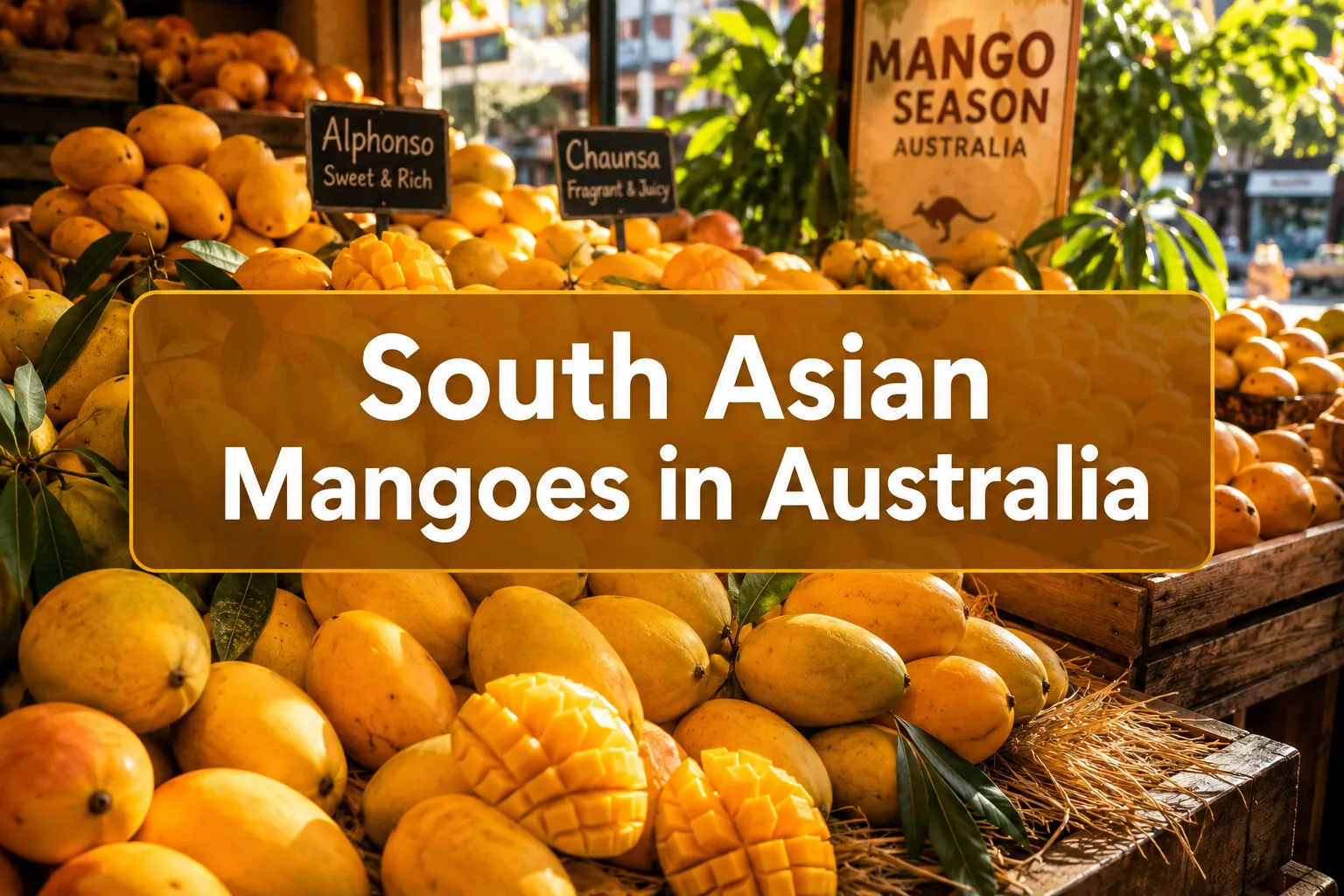
Quick Answer: South Asian mangoes, including Indian Alphonso and Pakistani Chaunsa varieties, arrive in Australia during the Australian winter (June through August), giving South Asian diaspora communities access to the flavors they grew up with. They are sold at specialist retailers, multicultural grocers, and seasonal festivals across major cities. Prices are higher than local Australian mangoes, but the distinct flavor, cultural significance, and limited seasonal window make them a sought-after treat.
Key Takeaways
- Peak season for South Asian mangoes in Australia is mid-July to mid-August 2026, with Pakistani varieties dominating this window [1]
- Popular varieties include Alphonso and Kesar (Indian) and Chaunsa, Sindhri, and Anwar Ratol (Pakistani)
- Prices typically range from AUD $15 to $50 per kilogram depending on variety and retailer, reflecting import and biosecurity costs
- South Asian mangoes must pass strict Australian biosecurity protocols before entering the country [8]
- The Pakistani Mango and Multicultural Food Festival 2026 drew over 30,000 visitors across Australian cities [5]
- Indian mango festivals in June and July 2026 have also brought communities together across Australia [2]
- South Asian mangoes are nutritionally rich, providing vitamin C, vitamin A, folate, and dietary fiber
- Specialist retailers such as Mango Man and Mango Wala serve diaspora demand in Sydney and Melbourne [4][10]
- Pakistani and Indian mangoes differ in flavor profile, texture, and season timing
- Storing mangoes at room temperature until ripe, then refrigerating, extends freshness by several days
What South Asian Mango Varieties Are Available in Australia
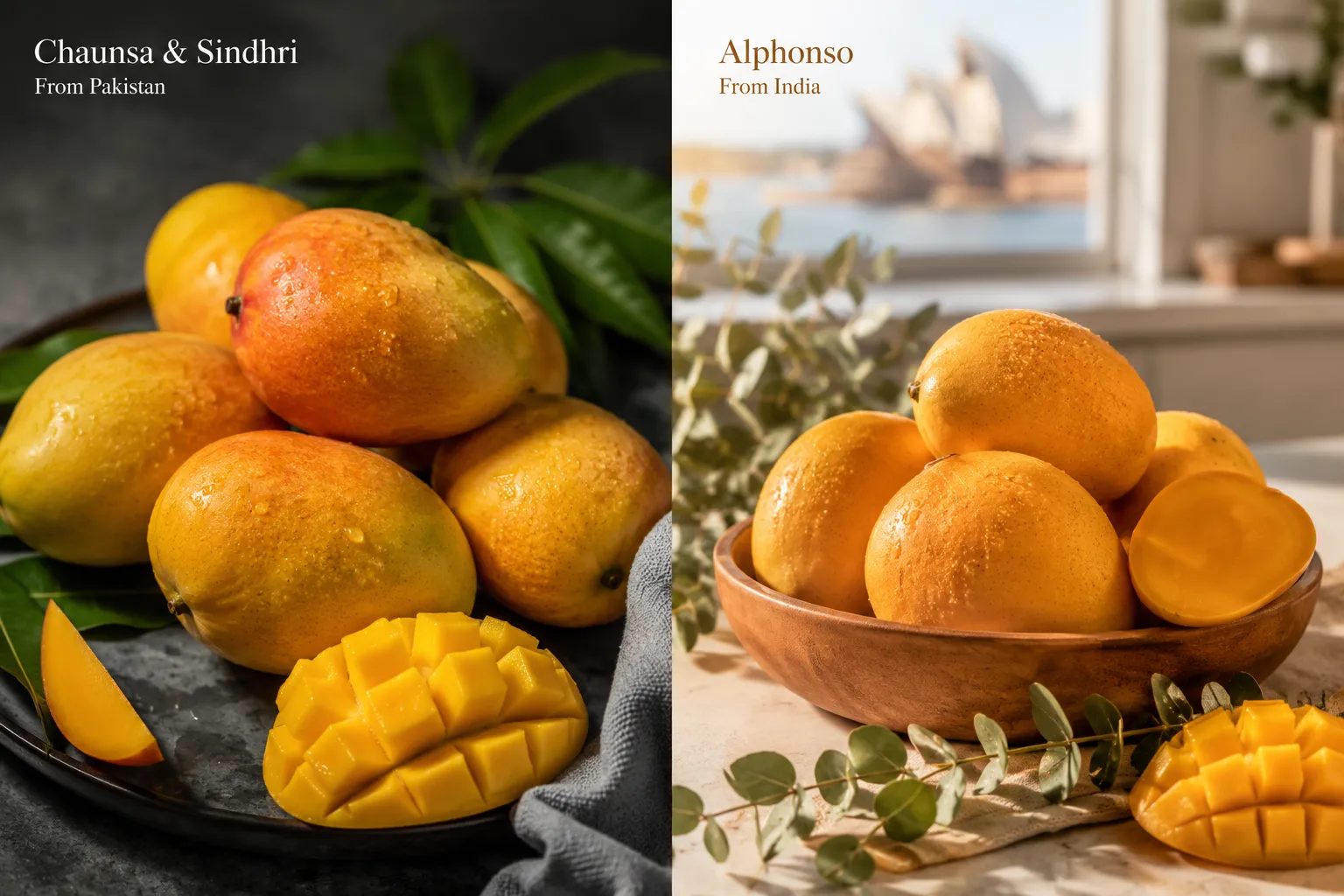
Several South Asian mango varieties reach Australian shelves each winter, though availability depends on import approvals and seasonal supply. The most commonly found are Indian Alphonso and Kesar, and Pakistani Chaunsa, Sindhri, and Anwar Ratol.
Indian varieties:
- Alphonso (Hapus): Dense, non-fibrous flesh with a rich, sweet flavor and deep orange color. Considered the benchmark variety by many connoisseurs [6]
- Kesar: Slightly smaller than Alphonso, with a honey-like sweetness and saffron-toned flesh; highly popular in Australian Indian communities [6]
Pakistani varieties:
- Chaunsa: Pale yellow skin, exceptionally sweet with a floral aroma, and almost no fiber. One of the most prized varieties in Australia [1]
- Sindhri: Large, oval-shaped, with a mild sweetness and smooth texture; often the first Pakistani variety to arrive each season [1]
- Anwar Ratol: Small but intensely sweet, with a short shelf life that makes it rare outside specialist stores [1]
Australia has approved specific Pakistani export facilities to supply these varieties, with two additional facilities cleared in recent years to meet growing demand [8].
Where to Buy South Asian Mangoes in Australia
South Asian mangoes are sold at specialist importers, multicultural grocery stores, and seasonal festivals. They are not typically found in mainstream supermarkets.
Key retail sources:
- Mango Man (mangoman.com.au): A dedicated importer and retailer supplying Indian and Pakistani mangoes in Sydney and Melbourne [4]
- Mango Wala (mangowala.com.au): A specialist retailer catering to the South Asian diaspora, offering pre-orders and home delivery [10]
- Multicultural grocery stores: Suburbs with large South Asian populations, such as Harris Park (Sydney), Dandenong (Melbourne), and Woodridge (Brisbane), have grocers stocking these varieties during peak season
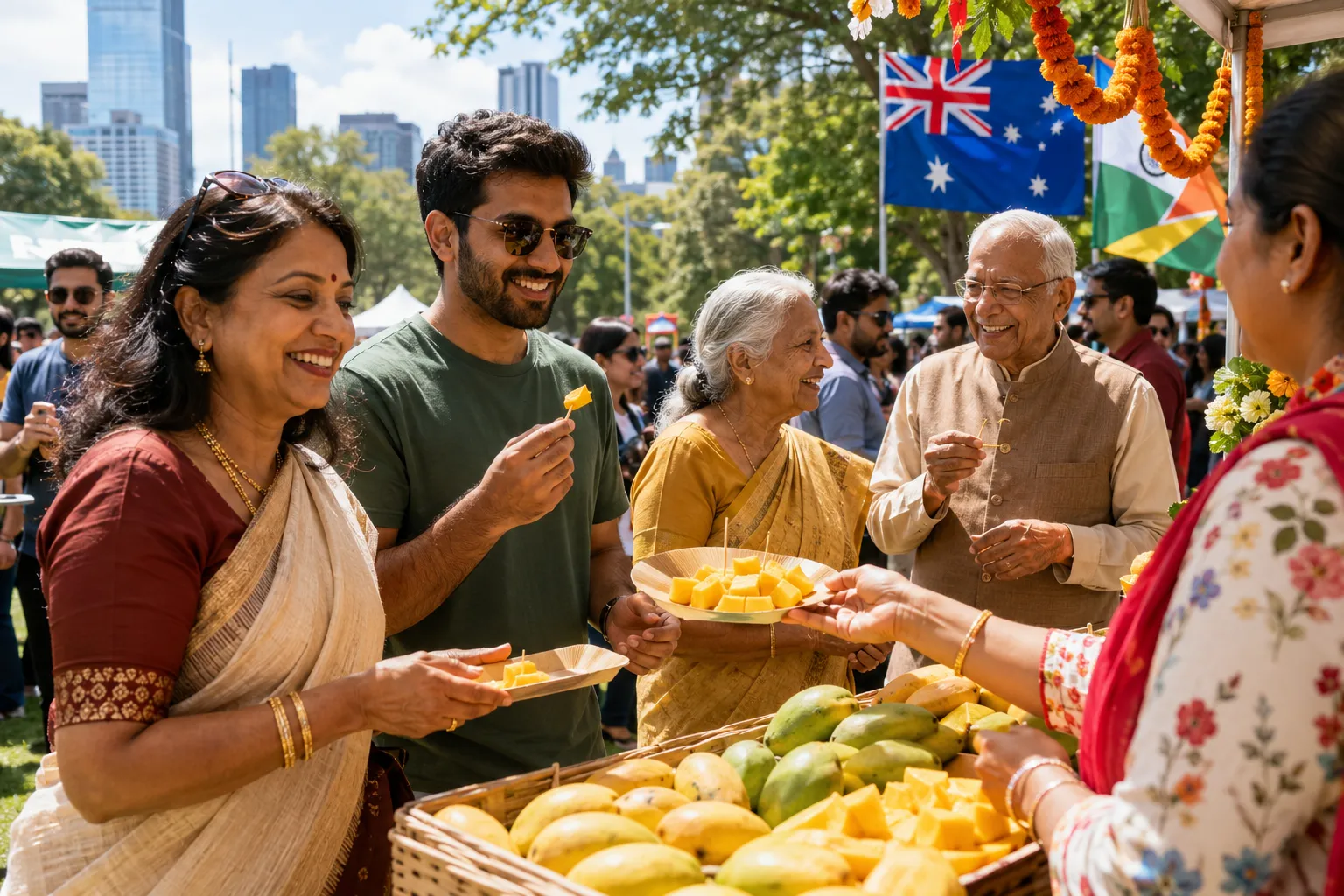
- Mango festivals: The Pakistani Mango and Multicultural Food Festival 2026 and Indian mango festivals in June and July 2026 are direct purchase points and tasting events [2][5]
Tip: Pre-ordering from specialist importers is the most reliable method. Stock sells out quickly during peak weeks in late July and early August.
How Much Do South Asian Mangoes Cost in Australia
South Asian mangoes in Australia are priced significantly higher than local varieties, typically between AUD $15 and $50 per kilogram. A box of premium Alphonso or Chaunsa can cost AUD $80 to $150 depending on weight and grade [1].
Prices vary based on:
- Variety: Anwar Ratol and premium Alphonso command the highest prices
- Grade: Export-grade fruit with uniform size and minimal blemishes costs more
- Retailer: Festival vendors and specialist importers may price differently
- Timing: Early-season and late-season stock can be pricier due to lower supply
Why Are South Asian Mangoes Expensive in Australia
The high cost reflects a chain of regulatory, logistical, and agricultural factors. South Asian mangoes must undergo irradiation or vapor heat treatment to meet Australian biosecurity requirements before export, which adds cost at the source [8][9].
Additional cost drivers include:
- International air freight (most premium mangoes are flown, not shipped, to preserve quality)
- Import duties and biosecurity inspection fees
- Cold chain logistics within Australia
- Limited approved export facilities, which constrains supply [8]
Pakistan’s government has been actively working to expand the number of approved export facilities to increase volume and reduce per-unit costs over time [9]. Still, for the 2026 season, prices remain at a premium level.
Best Time to Buy South Asian Mangoes in Australia in July 2026
Mid-July to mid-August 2026 is the optimal window for buying Pakistani mangoes in Australia, with Indian varieties typically available from late May through July [1][2].
Seasonal calendar (approximate):
| Variety | Origin | Peak Availability in Australia |
|---|---|---|
| Alphonso | India | Late May – early July |
| Kesar | India | June – mid July |
| Sindhri | Pakistan | Late June – late July |
| Chaunsa | Pakistan | Mid July – mid August |
| Anwar Ratol | Pakistan | Late July – early August |
July 27, 2026 (the publication date of Shadi Khan Saif’s piece in The Guardian) falls squarely within peak Pakistani mango season, making it an ideal moment to source Chaunsa and Anwar Ratol from specialist retailers.
Difference Between Indian and Pakistani Mangoes
Indian and Pakistani mangoes come from neighboring regions but have distinct flavor profiles, textures, and culinary uses. Neither is universally superior; the preference is personal.
Indian mangoes (Alphonso, Kesar):
- Richer, more complex sweetness with slight tartness
- Firmer flesh, ideal for slicing and eating fresh
- Deep orange-red skin color when ripe
- Widely used in desserts like aamras and mango lassi
Pakistani mangoes (Chaunsa, Sindhri):
- Sweeter, more floral aroma with lower acidity
- Softer, almost custard-like texture when fully ripe
- Pale yellow to gold skin
- Often eaten by squeezing and drinking directly from the skin
The rivalry between fans of each country’s mangoes is a running cultural joke, but as Shadi Khan Saif noted in The Guardian on July 27, 2026, the shared love of the fruit across the India-Pakistan divide is itself a form of connection.
How to Tell If a South Asian Mango Is Ripe
A ripe South Asian mango gives slightly under gentle thumb pressure and has a strong, sweet fragrance near the stem end. Do not rely on color alone, as many varieties remain pale yellow even when fully ripe.
Ripeness checklist:
- Gentle give when pressed (not mushy, not rock-hard)
- Sweet, floral scent at the stem
- Skin may show faint wrinkles on Chaunsa when overripe
- No sour or fermented smell
Common mistake: Buying pre-ripened mangoes from a refrigerated display. Cold storage halts ripening but can damage texture. Always buy firm fruit and ripen at home.
How to Store South Asian Mangoes to Keep Them Fresh
Store unripe mangoes at room temperature, away from direct sunlight, until they reach the desired ripeness. Once ripe, move them to the refrigerator, where they will keep for two to four days.
Storage tips:
- Do not stack mangoes on top of each other; bruising accelerates spoilage
- A paper bag speeds up ripening by trapping ethylene gas
- Cut mango flesh can be stored in an airtight container in the fridge for up to three days
- Freezing mango chunks works well for smoothies and cooking, though texture softens after thawing
South Asian Mangoes vs Australian Mangoes: Taste Comparison
Australian mangoes (primarily Kensington Pride, R2E2, and Honey Gold) are excellent in their own right but differ meaningfully from South Asian varieties. Australian mangoes are generally milder, slightly fibrous, and have a tropical-citrus flavor profile suited to fresh eating and smoothies.
South Asian mangoes tend to have:
- Higher sugar concentration and more complex aroma compounds
- Less fiber (especially Chaunsa and Alphonso)
- A richer, more perfumed finish
For diaspora communities, the difference is not just taste but memory. The scent of a ripe Alphonso or Chaunsa can evoke childhood summers in Mumbai or Lahore in a way that a Kensington Pride cannot replicate. This emotional dimension is a significant part of why South Asian mangoes command both loyalty and premium pricing in Australia.
Can You Import Mangoes From India and Pakistan to Australia
Yes, but only through regulated channels. Both Indian and Pakistani mangoes can enter Australia under strict biosecurity protocols managed by the Department of Agriculture, Fisheries and Forestry (DAFF).
Key requirements:
- Mangoes must be treated (irradiation or vapor heat treatment) at approved facilities before export [8][9]
- Only certified exporters from approved facilities can supply the Australian market
- The first consignment of Indian mangoes to Australia under formal protocols was a landmark event that established the current framework [3]
- Pakistan has been expanding its list of DAFF-approved facilities to meet growing Australian demand [8]
Private individuals cannot legally bring fresh mangoes into Australia in their luggage. Attempting to do so risks biosecurity fines and confiscation.
Best South Asian Mango Varieties for Beginners
For someone trying South Asian mangoes for the first time, Alphonso (Indian) and Sindhri (Pakistani) are the best entry points. Both are widely available, forgiving in terms of ripeness window, and representative of their respective origins.
- Alphonso: Familiar sweetness with a slight tang; firm enough to slice cleanly
- Sindhri: Mild, approachable sweetness without the intense floral intensity of Chaunsa
Avoid starting with Anwar Ratol; its very short shelf life means it is often overripe by the time it reaches retail, which can give a misleading first impression.
What Dishes Use South Asian Mangoes
South Asian mangoes are versatile in both sweet and savory cooking. Their low fiber and high sugar content make them especially suited to desserts and drinks.
Popular uses:
- Aamras: Pureed Alphonso mango served with puri bread (Indian)
- Mango lassi: Blended mango with yogurt and a pinch of cardamom
- Chaunsa milkshake: A Pakistani household staple during mango season
- Mango pickle (achar): Uses raw or semi-ripe fruit with mustard oil and spices
- Mango kulfi: Dense South Asian ice cream with mango pulp
- Fresh eating: Most South Asian families eat premium mangoes simply, sliced or squeezed
For ideas on pairing seasonal fruit with outdoor cooking, see our guide to barbeque maintenance and safe grilling practices for summer and winter entertaining.
Nutritional Benefits of South Asian Mangoes
South Asian mangoes are nutritionally dense. A 100-gram serving of Alphonso mango provides approximately 60 calories, along with meaningful amounts of vitamin C, vitamin A (as beta-carotene), folate, and potassium. These are estimates based on standard nutritional databases for ripe mango flesh.
Key nutrients (per 100g, approximate):
- Vitamin C: 36 mg (supports immune function)
- Vitamin A: 54 mcg RAE (supports eye health)
- Folate: 43 mcg (important for cell repair)
- Dietary fiber: 1.6 g (supports digestive health)
- Natural sugars: 13-15 g (varies by variety)
Mangoes also contain polyphenols, including mangiferin, which has been studied for antioxidant properties. For a broader look at how nutrients from whole foods compare with supplementation, the evidence on vitamins and supplements as a treatment offers useful context.
Mango Allergies and South Asian Varieties
Mango allergies exist but are uncommon. The most frequent reactions are contact dermatitis from mango skin, caused by urushiol, the same compound found in poison ivy. This is more common with South Asian varieties that have thinner, more resinous skin.
Who is at risk:
- People with known urushiol sensitivity (poison ivy, poison oak reactions)
- Individuals with latex-fruit syndrome may also react to mango
- True mango pulp allergy (IgE-mediated) is rare but documented
Practical steps:
- Peel mangoes with gloves if you have sensitive skin
- Avoid touching your face after handling mango skin
- If you experience hives, swelling, or breathing difficulty after eating mango, seek medical advice promptly
For general guidance on health and wellness topics, visit the health section for more evidence-based articles.
Are South Asian Mangoes Worth the Price
For most South Asian diaspora members in Australia, the answer is yes. The combination of flavor, cultural significance, and seasonal scarcity justifies the premium for those who grew up eating these varieties.
For newcomers or curious buyers, the value depends on expectations:
- Worth it if: You value complex, low-fiber sweetness, want to experience a culturally significant food, or are buying for a family gathering or festival
- Less worth it if: You primarily want a mango for smoothies or cooking where flavor nuance is lost, in which case Australian varieties or frozen pulp offer better value
The Pakistani Mango and Multicultural Food Festival 2026, which drew over 30,000 visitors, suggests that demand and perceived value remain strong across both diaspora and mainstream Australian audiences [5][7].
FAQ
When do South Asian mangoes arrive in Australia each year? Indian varieties (Alphonso, Kesar) typically arrive from late May through July. Pakistani varieties (Chaunsa, Sindhri, Anwar Ratol) peak from mid-July to mid-August. Exact timing shifts slightly each year based on harvest conditions.
Can I order South Asian mangoes online in Australia? Yes. Retailers such as Mango Man and Mango Wala offer online pre-orders with home delivery in Sydney and Melbourne [4][10]. Pre-ordering is recommended as stock sells out quickly during peak weeks.
Are South Asian mangoes organic? Most imported South Asian mangoes are not certified organic under Australian standards. They are treated with irradiation or vapor heat treatment as a biosecurity requirement, which some consumers factor into their buying decision.
How many mangoes come in a standard box? A standard retail box typically contains 6 to 12 mangoes depending on variety and size, weighing between 3 and 5 kilograms. Premium small-box options (3 kg) are common from specialist importers.
Do South Asian mangoes taste different in Australia than in their home country? Slightly. Air freight preserves quality well, but mangoes eaten tree-ripened in India or Pakistan have a depth of flavor that is difficult to fully replicate. Post-harvest handling and the time between picking and eating affect the final taste.
Is it legal to bring mango seeds or plants from South Asia into Australia? No. Bringing mango seeds, cuttings, or plant material into Australia without a specific import permit is prohibited under biosecurity law. Penalties can be significant.
What is the Pakistani Mango and Multicultural Food Festival? It is an annual event held in Australian cities that celebrates Pakistani mangoes and South Asian food culture. The 2026 edition drew over 30,000 visitors and featured mango tastings, cultural performances, and food stalls [5][7].
How do Indian mango festivals in Australia differ from Pakistani ones? Indian mango festivals focus primarily on Alphonso and Kesar varieties and often tie into broader Indian cultural celebrations in June and July [2]. Pakistani festivals center on Chaunsa and Sindhri and typically run in late July and August, aligned with peak Pakistani mango season [5].
Can diabetics eat South Asian mangoes? Mangoes have a moderate glycemic index. People managing blood sugar should consume them in moderation and ideally pair them with protein or fat to slow sugar absorption. Consulting a healthcare provider for personalized advice is recommended.
Why are Anwar Ratol mangoes so hard to find in Australia? Anwar Ratol has an extremely short post-harvest shelf life of three to five days, making logistics from Pakistan to Australian retail shelves very challenging. Only a small quantity reaches consumers in peak condition each season [1].
Conclusion
South Asian mangoes in Australia: a taste of home this July 2026 is more than a seasonal food story. It is a window into how food carries culture, memory, and community across borders. For the South Asian diaspora in Australia, the arrival of Alphonso, Chaunsa, and Sindhri each winter is a reliable anchor to home, made possible by years of regulatory work, specialist importers, and growing multicultural demand.
Actionable next steps:
- Pre-order now. Contact Mango Man or Mango Wala online to secure a box before peak-season stock runs out [4][10]
- Attend a festival. Check local listings for Indian and Pakistani mango festivals in your city during July and August 2026 [2][5]
- Start with Alphonso or Sindhri if you are new to South Asian mangoes, then work toward Chaunsa and Anwar Ratol as your palate develops
- Store correctly. Ripen at room temperature, refrigerate once ripe, and consume within four days for the best experience
- Share the experience. These mangoes are best enjoyed communally, as they have been for generations across South Asia
The shared love of a fragrant, golden mango, whether it comes from a farm in Maharashtra or Multan, has a quiet power to connect people across histories that have often divided them. That is worth the price of a box.
References
[1] Pakistani Mangoes In Australia Buying Guide – https://mmafarms.com/blog/pakistani-mangoes-in-australia-buying-guide/ [2] Indian Mango Festivals Bring A Taste Of Home To Communities Across Australia – https://www.theindiansun.com.au/2026/06/13/indian-mango-festivals-bring-a-taste-of-home-to-communities-across-australia/ [3] First Consignment of Indian Mangoes Arrive in Australia – https://in.thedollarbusiness.com/news/first-consignment-of-indian-mangoes-arrive-in-australia/50196 [4] Mango Man Australia – https://mangoman.com.au/ [5] Pakistani Mango Multicultural Food Festival 2026 – https://www.nation.com.pk/19-Jul-2026/pakistani-mango-multicultural-food-festival-2026 [6] Alphonso Kesar In Demand: Australia Imports Indian Mangoes – https://www.business-standard.com/article/economy-policy/alphonso-kesar-in-demand-in-a-first-australia-to-import-indian-mangoes-117042400154_1.html [7] Mango Festival 2026: The Sweetness of Pakistani Mangoes Bringing Cultures Together in Australia – https://www.sbs.com.au/language/urdu/en/podcast-episode/mango-festival-2026-the-sweetness-of-pakistani-mangoes-is-bringing-cultures-together-in-australia/lm89aguss [8] Australia Approves Two More Pakistan Mango Facilities For Export – https://www.freshplaza.com/asia/article/9324670/australia-approves-two-more-pakistan-mango-facilities-for-export/ [9] Pakistan Ministry of National Food Security and Research – https://mnfsr.gov.pk/NewsDetail/YWUzNTY1NzgtYmVhYi00ZGNiLWE5NWMtOGU3YTEwNmMzNzA5 [10] Mango Wala Australia – https://mangowala.com.au/

