

Last updated: June 30, 2026
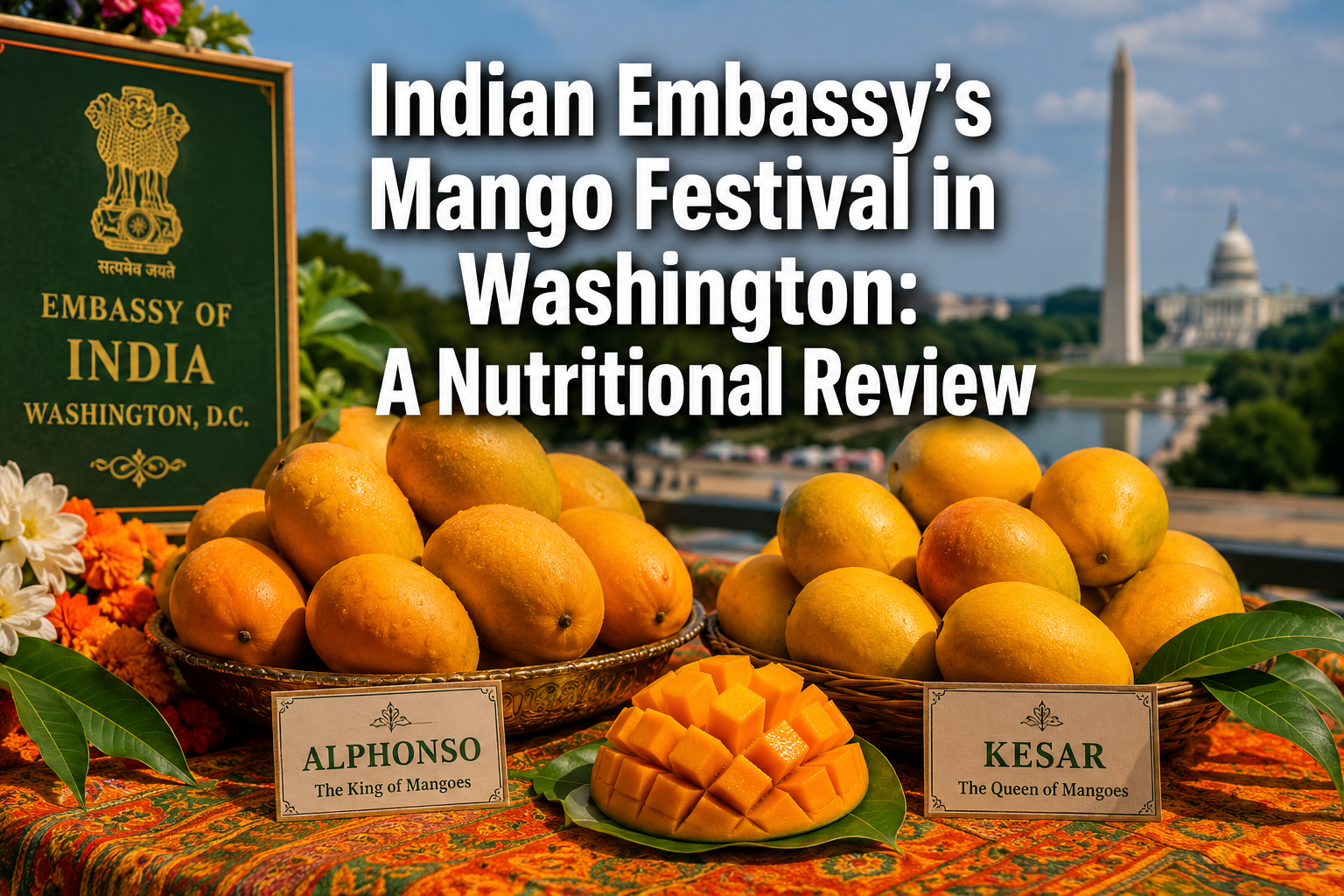
Quick Answer: The Indian Embassy’s Mango Festival in Washington, D.C., drew over 8,000 attendees in 2026, showcasing eight premium Indian mango varieties alongside traditional foods and drinks. Beyond the cultural celebration, the event highlights mangoes as a nutrient-dense fruit rich in vitamin C, fiber, potassium, and antioxidants. This nutritional review connects the festival’s offerings to the science-backed health benefits of eating Indian mangoes.
Key Takeaways
- The Indian Embassy’s Mango Festival in Washington attracted more than 8,000 visitors, making it one of the most attended Indian cultural food events in the U.S. [1]
- Eight mango varieties were featured, including Alphonso, Kesar, Dasheri, and Langra, each with distinct flavor profiles and slightly different nutritional compositions. [2]
- A single 3/4-cup serving of mango provides roughly 50% of the daily recommended intake of vitamin C. [4]
- Mangoes contain over 20 vitamins and minerals, including folate, potassium, magnesium, and vitamin A. [4]
- The fruit’s fiber content supports digestion, while its antioxidants may help reduce inflammation.
- People with diabetes should consume mangoes in moderation due to their natural sugar content, but the glycemic load of a standard serving is manageable for most.
- Alphonso and Kesar mangoes are lower in calories per serving compared to some tropical fruit alternatives, making them reasonable choices for weight-conscious eaters.
- India is the world’s largest mango producer, and export growth to the U.S. is constrained by limited irradiation and cold-chain infrastructure. [8]
- Organizers plan to expand available varieties to 15-20 in the coming year, signaling growing mainstream U.S. market interest. [2]
What Is the Indian Embassy Mango Festival in Washington, D.C.?
The Indian Embassy’s Mango Festival in Washington is an annual tasting event organized by the Embassy of India and the Agricultural and Processed Food Products Export Development Authority (APEDA). The festival brings premium Indian mango varieties directly to American consumers, combining cultural diplomacy with agricultural promotion. [5]
The event serves a dual purpose: it celebrates the cultural identity of mangoes in India while building commercial awareness of Indian exports in the U.S. market. Attendees sample fresh mangoes, enjoy mango-based dishes, and learn about the fruit’s regional origins across India. In 2026, the festival drew over 8,000 people, far exceeding initial expectations and reflecting strong public appetite for authentic Indian produce. [1]
Why it matters nutritionally: Most American consumers encounter only a handful of mango varieties in supermarkets. The festival exposes attendees to a broader range of varieties, each with subtle differences in sugar content, texture, and micronutrient density.
When Does the Indian Embassy Mango Festival Happen?
The festival typically takes place in late June, timed to coincide with the peak of India’s mango harvest season, which runs from April through July. The 2026 event was held in Washington, D.C., in late June. [3]
Mango season in India is brief, which is why the festival’s timing is deliberate. Indian mangoes exported to the U.S. must undergo irradiation treatment before entry, so the window for fresh availability is narrow. Attending during this period gives consumers the best chance to taste mangoes at their nutritional peak, when sugar and vitamin concentrations are highest.
What Types of Mangoes Are Featured at the Indian Embassy Festival?
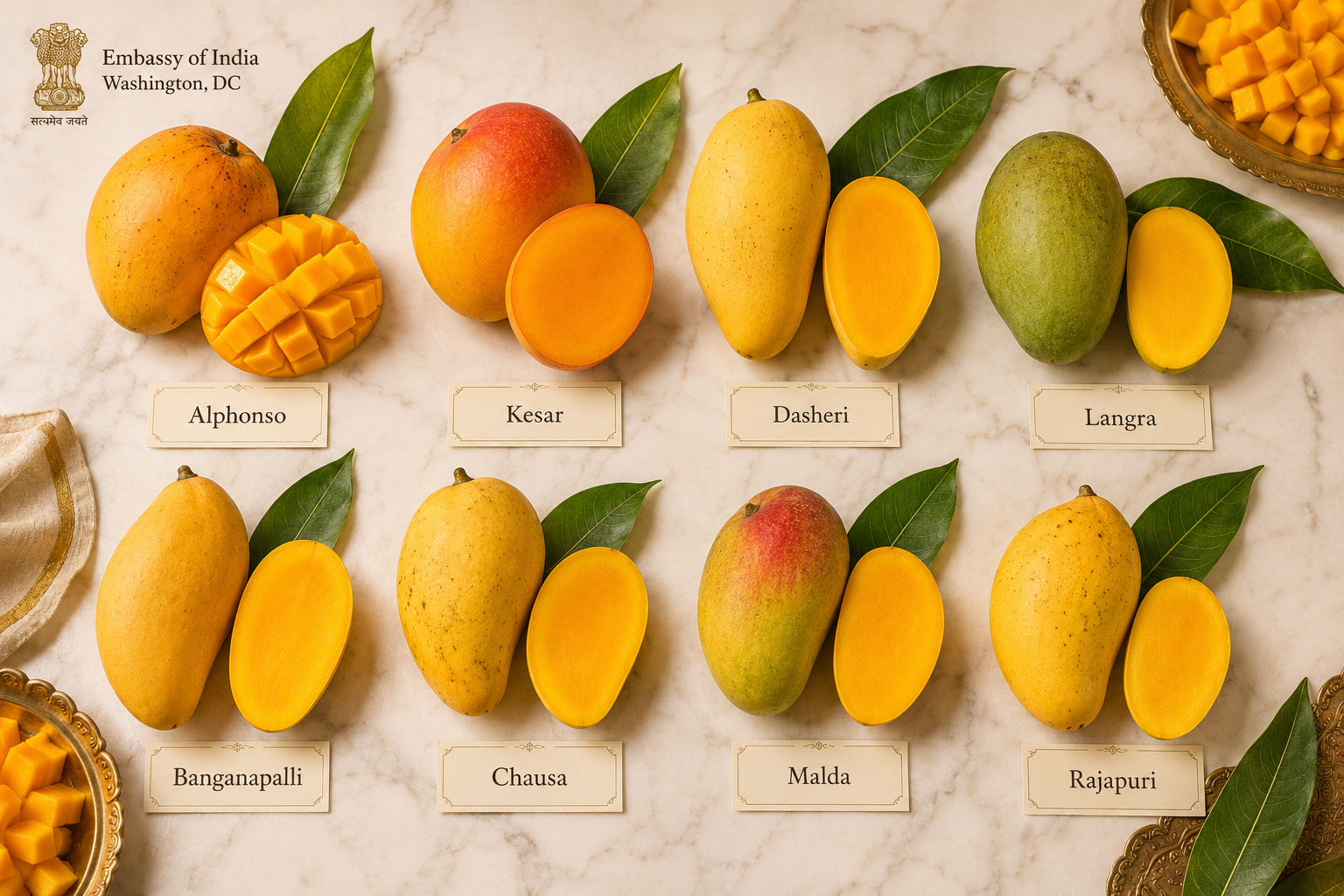
Eight distinct Indian mango varieties were available at the 2026 festival: Alphonso, Kesar, Dasheri, Langra, Banganapalli, Chausa, Malda, and Rajapuri. [2] Each variety originates from a different Indian state and carries a unique flavor, color, and texture.
| Variety | Origin Region | Flavor Profile | Notable Trait |
|---|---|---|---|
| Alphonso | Maharashtra | Rich, creamy, sweet | Most exported; low fiber |
| Kesar | Gujarat | Honey-sweet, aromatic | Deep orange flesh |
| Dasheri | Uttar Pradesh | Mild, fiberless | Long shelf life |
| Langra | Varanasi | Tangy-sweet | Green skin when ripe |
| Banganapalli | Andhra Pradesh | Mild, firm | Large size |
| Chausa | North India | Extremely sweet | Sucked, not sliced |
| Malda | Bihar/Bengal | Soft, juicy | Regional favorite |
| Rajapuri | Gujarat | Mild sweetness | Often used in pickles |
Organizers plan to expand this selection to 15-20 varieties in the near future as export infrastructure improves. [2]
How Many Calories Are in Mango Varieties at the Festival, and How Does Nutritional Content Differ?
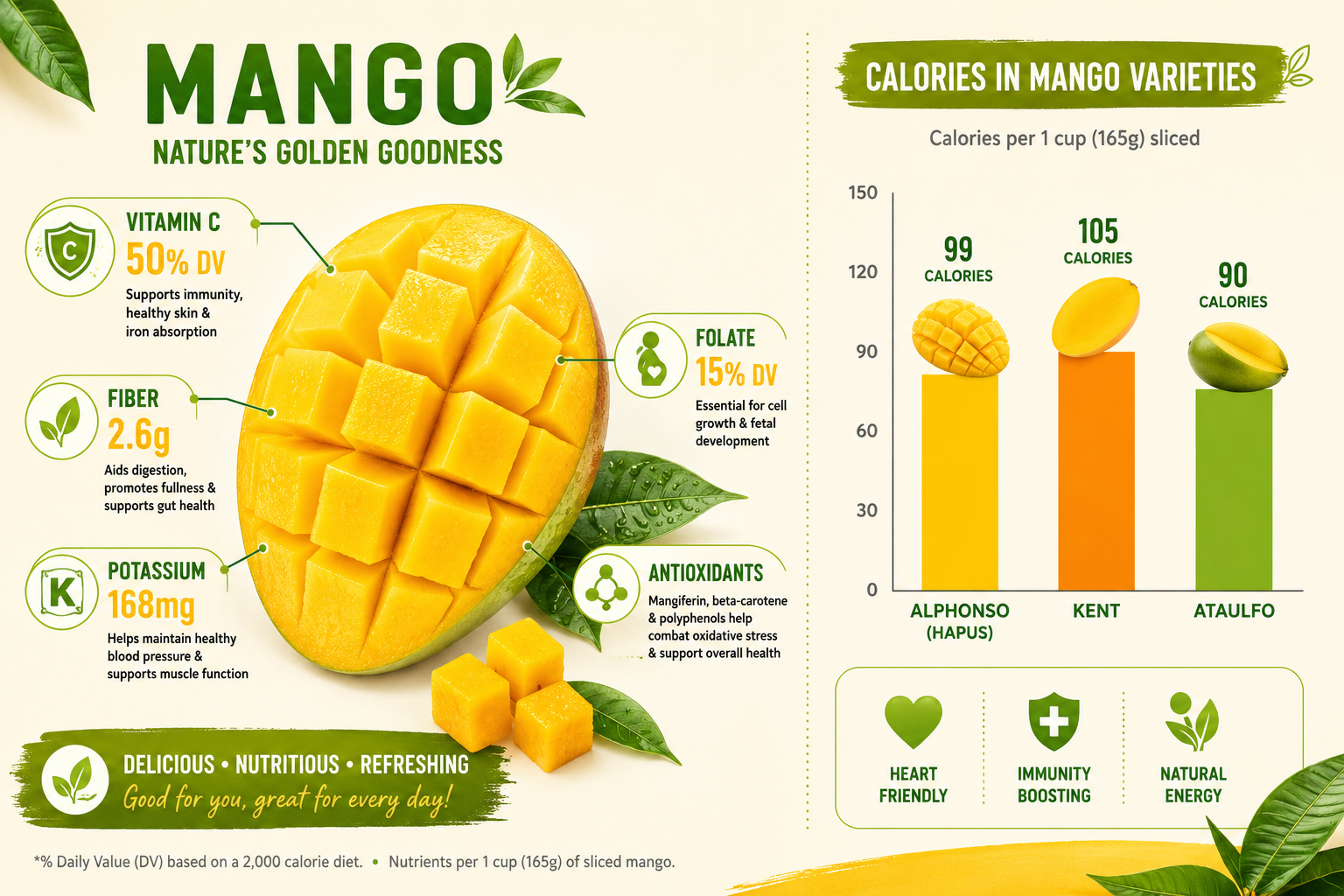
A standard 3/4-cup (approximately 124g) serving of fresh mango contains roughly 70-80 calories, depending on the variety. Sweeter, denser varieties like Chausa and Alphonso sit toward the higher end of that range, while firmer varieties like Banganapalli tend to be slightly lower in sugar and calories.
The nutritional differences between varieties are modest but worth noting:
- Sugar content: Chausa and Alphonso are among the sweetest, with higher fructose levels per serving. Dasheri and Banganapalli are comparatively less sweet.
- Fiber: Most Indian varieties contain 1.5-2g of dietary fiber per serving. Dasheri is notably low in fiber due to its fiberless flesh.
- Vitamin C: All varieties provide a significant vitamin C boost. A single 3/4-cup serving delivers approximately 50% of the daily recommended intake. [4]
- Vitamin A: Orange-fleshed varieties like Kesar and Alphonso are richer in beta-carotene, the precursor to vitamin A.
- Folate: Present across all varieties, folate supports cell function and is especially important during pregnancy.
Common mistake: Assuming all mangoes are nutritionally identical. Variety, ripeness, and serving size all affect the actual nutrient and calorie count.
What Nutritional Benefits Do Mangoes Have?
Mangoes are one of the most nutrient-dense tropical fruits available. A single serving provides over 20 vitamins and minerals, including vitamin C, vitamin A, folate, potassium, and magnesium. [4]
Key health benefits supported by research include:
- Immune support: The high vitamin C content supports white blood cell production and skin barrier function.
- Digestive health: Fiber in mangoes feeds beneficial gut bacteria and supports regular bowel movements. Mangoes also contain amylases, enzymes that help break down complex carbohydrates.
- Heart health: Potassium and magnesium in mangoes support healthy blood pressure levels.
- Anti-inflammatory properties: Mangoes contain polyphenols and carotenoids, antioxidants that may reduce oxidative stress and chronic inflammation. [4]
- Eye health: Beta-carotene and lutein, found in higher concentrations in orange-fleshed varieties, support retinal health.
“A single serving of mango provides 50% of the daily recommended intake of vitamin C, making it one of the most efficient fruit sources of this essential nutrient.” [4]
Do Mangoes Have Fiber and Vitamins? A Closer Look
Yes. Mangoes are a reliable source of both dietary fiber and multiple vitamins. One 3/4-cup serving provides approximately 2g of fiber, which contributes to the recommended daily intake of 25-38g for adults. [4]
The vitamin profile is broad:
- Vitamin C: 50% of the daily value per serving
- Vitamin A (as beta-carotene): Significant in orange-fleshed varieties
- Folate (B9): Supports DNA synthesis and is critical during pregnancy
- Vitamin B6: Supports brain health and metabolism
- Vitamin K: Present in smaller amounts; supports blood clotting
Mangoes also contain trace amounts of calcium, iron, and zinc, though they are not primary sources of these minerals.
Are There Sugar Concerns With Eating Mangoes, and Is the Festival Good for People With Diabetes?
Mangoes do contain natural sugars, primarily fructose, at roughly 15-17g per 3/4-cup serving. This is a legitimate consideration for people managing blood sugar. However, the glycemic index of mango is moderate (approximately 51-56), and the glycemic load of a standard serving is low enough that most people, including those with well-managed type 2 diabetes, can include mango in a balanced diet.
For people with diabetes:
- Stick to a single serving (about 3/4 cup or 124g) at one sitting.
- Pair mango with a source of protein or healthy fat to slow glucose absorption.
- Avoid mango juice, mango lassi, and mango halwa served at the festival, as these are significantly higher in sugar and lack the fiber of whole fruit.
- Consult a registered dietitian before making changes to a diabetes meal plan.
The festival itself is not specifically designed for diabetic attendees, but the fresh mango tasting stations are the most diabetes-friendly option available. [3]
Can You Eat Too Many Mangoes? Health Considerations
Yes, overconsumption is possible. Eating large quantities of mango in one sitting can cause digestive discomfort, a rapid rise in blood sugar, and excess calorie intake. The festival setting, with multiple free samples, makes it easy to eat more than a standard serving without realizing it.
Practical limits to keep in mind:
- One to two servings per day is a reasonable upper limit for most healthy adults.
- People with fructose malabsorption may experience bloating or cramping from large mango portions.
- The mango lassi and mango halwa served at the festival contain added sugar and dairy, which significantly increases calorie and carbohydrate load compared to fresh fruit.
Edge case: People taking blood thinners should note that mango contains vitamin K, which can interact with warfarin at very high intake levels. This is unlikely to be an issue at festival serving sizes, but it is worth flagging.
What Are the Best Mangoes for Weight Loss?
For weight-conscious eaters, lower-sugar, higher-fiber varieties are the better choice. Banganapalli and Dasheri are relatively mild in sweetness, while Langra offers a good balance of flavor and moderate sugar content.
General guidance:
- Choose fresh mango over mango-based desserts or drinks at the festival.
- A 3/4-cup serving of fresh mango at roughly 70-80 calories is a satisfying, nutrient-dense snack.
- The fiber content helps increase satiety, which can reduce overall calorie intake later in the day.
- Avoid the mango halwa and sweetened lassi if calorie control is a priority.
How Is the Indian Embassy Mango Festival Different From Other Fruit Festivals in D.C.?
Most fruit festivals in the Washington, D.C., area focus on locally grown produce such as strawberries, peaches, or apples. The Indian Embassy’s Mango Festival is distinct in several ways:
- Variety depth: Eight or more imported mango varieties in one location is unusual for any U.S. event. [2]
- Cultural context: The festival pairs food with cultural programming, connecting the fruit to its agricultural and historical roots in India. [7]
- Trade and diplomacy: APEDA’s involvement gives the event a formal trade promotion dimension, with exporters and U.S. retailers present alongside the general public. [5]
- Culinary range: Beyond fresh fruit, the festival offers mango lassi, biryani, mango halwa, Indian tea, and coffee, making it a full cultural food experience rather than a simple tasting. [3]
Is the festival free to attend? Based on available reporting, the event has been open to the public without a ticket fee, though this may vary by year. Checking the Indian Embassy’s official website before attending is advisable.
What Mango Dishes Are Served at the Festival?
The 2026 festival featured fresh mango tastings alongside a range of prepared dishes and beverages. [3] The culinary lineup included:
- Mango lassi: A blended yogurt and mango drink, popular across North India
- Mango halwa: A sweet, dense dessert made from mango pulp, sugar, and ghee
- Biryani: Fragrant rice dish served as a savory complement to the sweet mango offerings
- Indian tea and coffee: Traditional chai and filter coffee as palate cleansers
From a nutritional standpoint, fresh mango tasting stations are the most nutrient-dense option. Mango lassi adds protein from yogurt but also increases sugar and calorie content. Mango halwa is a dessert and should be treated as such, not as a health food.
How Does the Festival Reflect India’s Mango Export Growth?
India is the world’s largest producer of mangoes, and the embassy festival is a direct reflection of the country’s push to expand its share of the U.S. market. [5] Exports have grown steadily, supported by APEDA-approved irradiation facilities that meet U.S. import requirements.
However, challenges remain. Limited irradiation treatment capacity and underdeveloped cold-chain infrastructure make large-scale, year-round supply difficult. [8] The festival itself has prompted calls from attendees and retailers for wider availability in mainstream U.S. supermarkets. [6]
The 8,000-plus attendance figure in 2026 signals genuine consumer demand that the export supply chain has not yet fully met. [1]
Conclusion
The Indian Embassy’s Mango Festival in Washington: A Nutritional Review reveals that this event is more than a cultural celebration. It is a practical demonstration of what mangoes offer nutritionally and why Indian varieties deserve a larger place in the American diet.
Actionable next steps:
- At the festival: Prioritize fresh mango tastings over sweetened preparations to maximize nutritional value and manage calorie intake.
- At home: Incorporate one serving (about 3/4 cup) of fresh mango daily during peak season for a reliable vitamin C and antioxidant boost.
- For people with diabetes: Stick to whole fruit, pair it with protein, and skip the sweetened drinks.
- For shoppers: Look for Alphonso, Kesar, or Banganapalli at Indian grocery stores in the U.S. during June and July, when fresh imports are most available.
- For the curious: Follow APEDA and the Indian Embassy’s announcements for the next festival date, as the event is expected to grow in both variety count and attendance.
The festival’s popularity confirms that American consumers are ready for a broader mango conversation, one that goes beyond the Tommy Atkins variety found in most supermarkets and into the richer, more nutritionally varied world of Indian mangoes.
FAQ
What is the Indian Embassy Mango Festival in Washington, D.C.? It is an annual public tasting event organized by the Embassy of India and APEDA to promote premium Indian mango varieties in the U.S. market. The 2026 event drew over 8,000 attendees.
When does the Indian Embassy Mango Festival take place? The festival is held in late June, timed to coincide with the peak of India’s mango export season.
Is the Indian Embassy Mango Festival free to attend? Based on available reporting, the event has been open to the public at no charge. Confirm current details on the Indian Embassy’s official website before attending.
How many calories are in a serving of mango? A standard 3/4-cup (124g) serving of fresh mango contains approximately 70-80 calories, depending on the variety.
Which mango variety is best for weight loss? Banganapalli and Langra are relatively lower in sugar compared to Alphonso or Chausa, making them slightly better choices for calorie-conscious eaters. Fresh mango is always preferable to mango-based sweets or drinks.
Can people with diabetes eat mangoes? Yes, in moderation. A single 3/4-cup serving has a moderate glycemic index and low glycemic load. Pairing mango with protein or fat slows glucose absorption. Sweetened mango products at the festival should be avoided.
What vitamins are in mangoes? Mangoes contain vitamin C (50% of daily value per serving), vitamin A, folate, vitamin B6, and vitamin K, along with minerals like potassium and magnesium.
What mango varieties are featured at the Indian Embassy festival? The 2026 festival featured Alphonso, Kesar, Dasheri, Langra, Banganapalli, Chausa, Malda, and Rajapuri. Organizers plan to expand to 15-20 varieties in future editions.
Are mangoes good for digestion? Yes. Mangoes contain dietary fiber and natural digestive enzymes called amylases, both of which support healthy digestion.
Why are Indian mangoes not widely available in U.S. supermarkets? Limited irradiation treatment facilities and underdeveloped cold-chain infrastructure restrict large-scale imports. The festival is partly designed to build consumer demand that could justify expanded supply.
What food is served at the Indian Embassy Mango Festival? Fresh mango tastings, mango lassi, mango halwa, biryani, Indian tea, and coffee were among the offerings at the 2026 event.
How does the festival differ from other fruit festivals in Washington, D.C.? It features imported Indian varieties unavailable at most U.S. events, includes a formal trade and diplomacy dimension through APEDA, and pairs fresh fruit with a full range of Indian culinary offerings.
References
[1] Indian Embassy’s Mango Tasting Event Draws Over 8000 People In Us – https://www.tribuneindia.com/news/usa-news/indian-embassys-mango-tasting-event-draws-over-8000-people-in-us/?utm_source=openai
[2] Hundreds Gather In Washington To Taste Indian Mangoes At Annual Mango Festival – https://www.mid-day.com/amp/news/world-news/article/hundreds-gather-in-washington-to-taste-indian-mangoes-at-annual-mango-festival-23637224?utm_source=openai
[3] Indian Mangoes Washington Embassy Tasting Us Exports Rise – https://www.indiatoday.in/amp/world/story/indian-mangoes-washington-embassy-tasting-us-exports-rise-ptag-2935877-2026-06-28?utm_source=openai
[4] Mango Nutrition – https://www.mango.org/mango-nutrition/?utm_source=openai
[5] Indian Embassy In Washington Apeda Organise Mango Festival – https://newsonair.gov.in/indian-embassy-in-washington-apeda-organise-mango-festival/?utm_source=openai
[6] Apeda Indian Embassy Push Premium Mango Varieties In Us To Tap Retail Market – https://theindianawaaz.com/apeda-indian-embassy-push-premium-mango-varieties-in-us-to-tap-retail-market/?utm_source=openai
[7] Indian Embassy’s Mango Festival In Washington Draws Huge Crowds – https://www.ndtv.com/food/indian-embassys-mango-festival-in-washington-draws-huge-crowds-11702412?utm_source=openai
[8] How Indian Mangoes Won America But Not Yet Market – https://americanbazaaronline.com/2026/06/27/how-indian-mangoes-won-america-but-not-yet-market-483652/?utm_source=openai
